Commercial Lighting in Southlake, Keller & Alliance: The LED Guide for Northeast Tarrant County Businesses
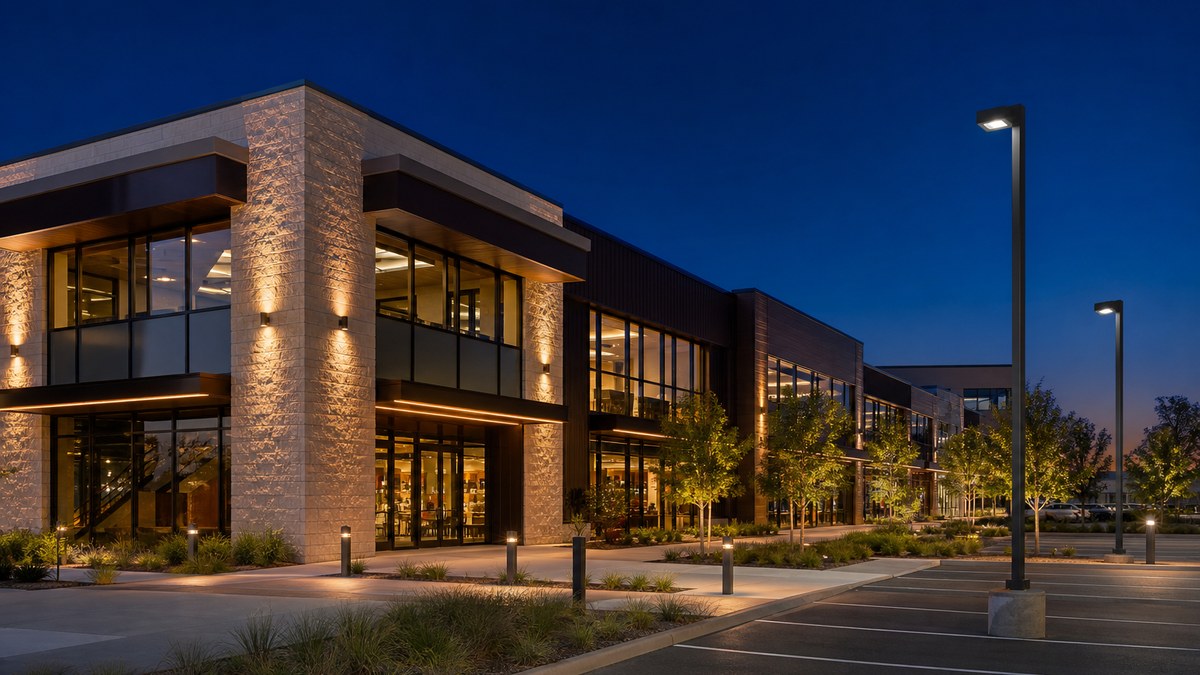
Commercial lighting in Southlake, Keller and Alliance has to do more than light a building. In this corner of northeast Tarrant County, a project has to look premium next to polished retail centers, respect neighbors in some of the most residential-minded cities in North Texas, keep logistics campuses running around the clock and pass inspection under whichever city's codes apply to the address. The fixtures, the controls and the paperwork are all different from one side of State Highway 114 to the other.
Fort Worth LED Lights works across Fort Worth and Tarrant County, and the Southlake, Keller and Alliance corridor is one of the busiest parts of that map. Retail and restaurant pads around Southlake's town center, medical and professional offices along the Keller corridors, and million-square-foot distribution buildings in the Alliance area all need lighting that is efficient, code-compliant and designed for the way the property is actually used.
This guide is for owners, property and facility managers, tenants planning a build-out, developers, architects and general contractors. It explains how lighting needs differ between Southlake, Keller and the Alliance area, which local rules usually come into play, what good lighting looks like for each building type, how a project runs from site walk to switch-on, and how to get a project-specific proposal. If you are searching for commercial lighting near me from anywhere in northeast Tarrant County, this is the place to start.
For commercial lighting in Southlake, Keller and the Alliance area, plan for:
- Confirming the jurisdiction first: Southlake, Keller and the City of Fort Worth (which covers much of Alliance) each have their own adopted codes, permits and inspections
- Neighbor-friendly exterior lighting: shielded, downward-aimed LED fixtures that control glare and light trespass, especially near homes
- An outdoor lighting plan where the city requires one, plus sign lighting that follows local sign rules
- Building-specific design: premium accent lighting for retail and restaurants, comfortable low-glare light for offices and clinics, high-output high bays with sensors for warehouses
- Energy-code lighting controls: occupancy sensors, schedules, dimming and daylight response
- Licensed installation: work performed by electricians licensed through the Texas Department of Licensing and Regulation (TDLR)
- Pricing: a project-specific proposal after a site walk and a review of your plans
Why northeast Tarrant County is its own lighting market
Southlake, Keller and the Alliance area sit only a few miles apart, but they are very different places to build and light. Treating them as one generic "DFW" market is how projects end up with fixtures that get flagged at inspection, glare complaints from the neighborhood next door or a storefront that looks dim next to the competition.
- Southlake is known for high-end retail, dining, corporate and professional offices, and residential neighborhoods that sit close to commercial corridors. Expectations for appearance are high and the city has its own outdoor lighting ordinance.
- Keller mixes neighborhood retail, restaurants, schools, churches, medical and professional offices with a strong small-town character. Its Unified Development Code includes lighting and glare standards and detailed sign rules.
- Alliance is dominated by logistics, manufacturing, aviation and large-format commercial development in north Fort Worth, with retail, hotels and offices growing around it. Lighting here is about scale, safety, uptime and energy use.
The common thread is LED. Whether a property needs a warm, inviting facade on a Southlake retail pad or tens of thousands of square feet of high bays in an Alliance distribution center, modern LED fixtures and controls deliver better light with less energy and maintenance than older metal halide, high-pressure sodium and fluorescent systems. For the broader picture, see our commercial LED lighting services guide.
Start with the address: which city's rules apply?
The first question on any project in this area is simple but easy to get wrong: which jurisdiction is the property actually in? City limits in northeast Tarrant County and southern Denton County are irregular, and a "Keller" or "Roanoke" mailing address does not always match the city that issues the permit.
Hillwood describes AllianceTexas as a 27,000-acre master-planned, mixed-use development in north Fort Worth that touches nine municipalities, five independent school districts and two counties. Many Alliance-area properties are inside Fort Worth city limits, but others fall under neighboring cities. Southlake and Keller each run their own building, planning and inspection departments.
For properties inside Fort Worth, the city's Building and Energy Codes information lists the 2015 International Energy Conservation Code (IECC) with local amendments for commercial buildings (with ASHRAE 90.1 as an alternative compliance path), the 2026 National Electrical Code effective September 1, 2026, and the 2021 International Building, Fire and Existing Building Codes. Southlake and Keller adopt their own code editions and amendments, so the right move is to confirm the adopted codes with that city's building department during design rather than assume they match Fort Worth.
| Area | Typical commercial properties | Lighting priorities | Rules to check early |
|---|---|---|---|
| Southlake | Retail centers, restaurants, corporate and professional offices, medical, hospitality | Premium appearance, warm facade and accent light, glare control, dark-sky friendly site lighting | Southlake outdoor lighting ordinance (Ordinance 693-C), sign rules, adopted building and energy codes |
| Keller | Neighborhood retail, restaurants, medical and professional offices, schools, churches | Neighbor-friendly site lighting, inviting storefronts, comfortable interiors | Keller Unified Development Code lighting and glare standards, sign rules, adopted building and energy codes |
| Alliance area (mostly north Fort Worth) | Distribution centers, manufacturing, aviation, flex, hotels, retail and offices | High-bay performance, dock and yard safety, round-the-clock operations, controls and energy use | Jurisdiction check, Fort Worth 2015 IECC with amendments where applicable, 2026 NEC, owner and tenant standards |
Southlake commercial lighting: premium, polished and neighbor-aware
Southlake's commercial districts set a high bar. Shoppers and diners expect storefronts, patios and walkways to feel warm and welcoming, and corporate tenants expect lobbies and offices to look as good as the building's architecture. At the same time, the city regulates outdoor lighting closely.
Southlake's outdoor lighting ordinance
Southlake has a dedicated outdoor lighting ordinance, Ordinance No. 693-C, adopted May 15, 2012 according to the American Planning Association's summary of it. That summary describes it as covering maximum illumination levels, how lighting levels are measured, maximum luminance levels, excess lighting and shielding requirements, lighting plans, appeals and variances, existing lighting and penalties, with exemptions for single- and two-family dwelling lighting, traffic control lighting and temporary lighting approved by the building official.
In practice, that means commercial site and building lighting in Southlake should be planned as a system, not picked from a catalog at the end of the job. Expect to think about:
- Shielding and aiming: fixtures that put light on the parking lot, walkway or facade instead of into the sky or a neighbor's backyard
- Light levels: enough light for safety and wayfinding without over-lighting, which the ordinance limits
- A lighting plan: fixture locations, cut sheets and calculated light levels submitted for review where required
- Existing lighting: how older fixtures on the site are handled when a property is renovated
The exact numerical limits and submittal requirements are in the ordinance and are administered by the city, so we confirm them with Southlake staff for every project.
What good looks like in Southlake
- Retail and restaurant facades: warm white (typically around 2700K to 3000K) grazing and wall-wash light on stone, brick and stucco, with integrated linear LED on canopies and architectural lines
- Patios and outdoor dining: dimmable, low-glare lighting that keeps the space comfortable after dark; see our restaurant lighting guide
- Corporate offices and lobbies: layered lighting with feature walls, downlights and daylight-responsive controls; see our architectural LED lighting guide
- Parking and walkways: fully shielded LED area lights, bollards and step lights that deliver even, comfortable light
- Signage: halo-lit or internally lit letters that follow the city's sign rules; see our LED signs guide
Keller commercial lighting: small-town character, modern LED
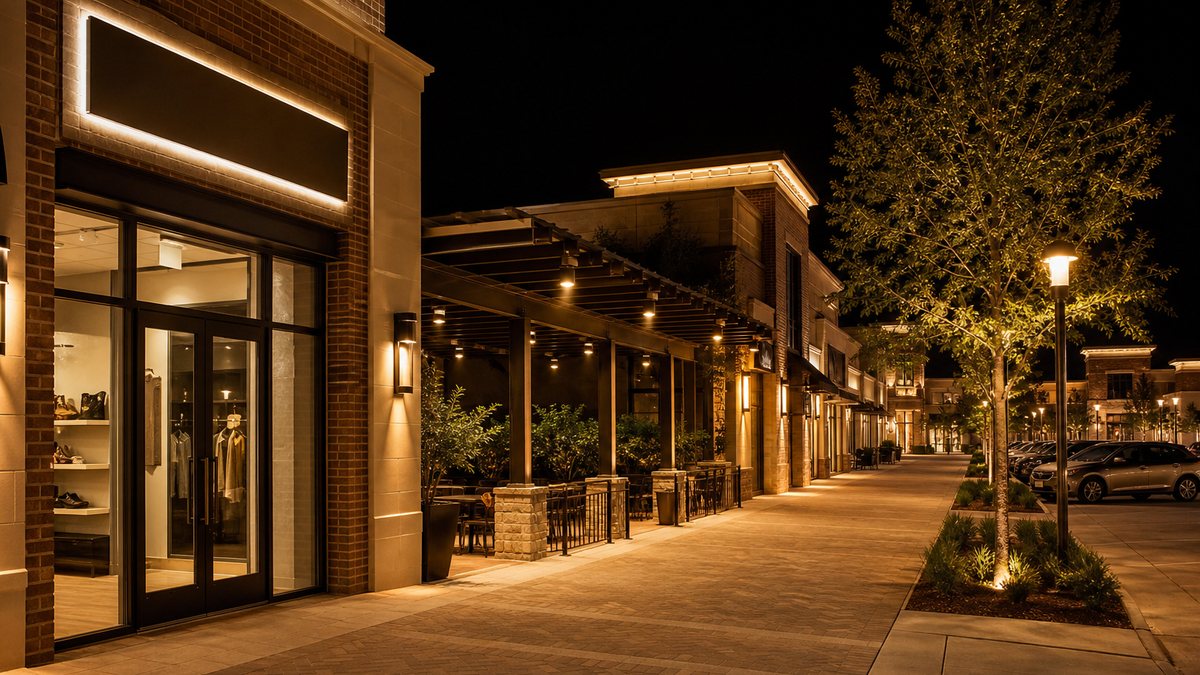
Keller's commercial corridors serve the people who live a few blocks away. Retail centers, restaurants, medical offices, schools and churches often back directly onto neighborhoods, which makes glare control and light trespass a design priority from day one.
Keller's lighting and sign standards
Keller's Unified Development Code includes a section on lighting and glare standards, along with detailed sign regulations that cover illuminated signs and electronic message boards, including how bright they can be and when they must turn off at night. The code also states that "the use of lighted stripes, exposed neon tubular lights or similar material on buildings or accessory structures shall not be permitted." That single line rules out a lot of the decorative LED tape and outline lighting that shows up on buildings in other cities, so it is worth checking before a tenant orders any accent lighting.
As with Southlake, we confirm current requirements with the city during design. Exterior lighting, signs and decorative lighting are where Keller projects most often need adjustment, so we deal with them early instead of at final inspection.
What good looks like in Keller
- Neighborhood retail centers: shielded LED area and wall lighting that keeps parking fields and sidewalks evenly lit without spilling into nearby yards
- Storefronts: interior display lighting and canopy downlights that make the store visible and inviting, instead of exterior outline lighting the code may not allow
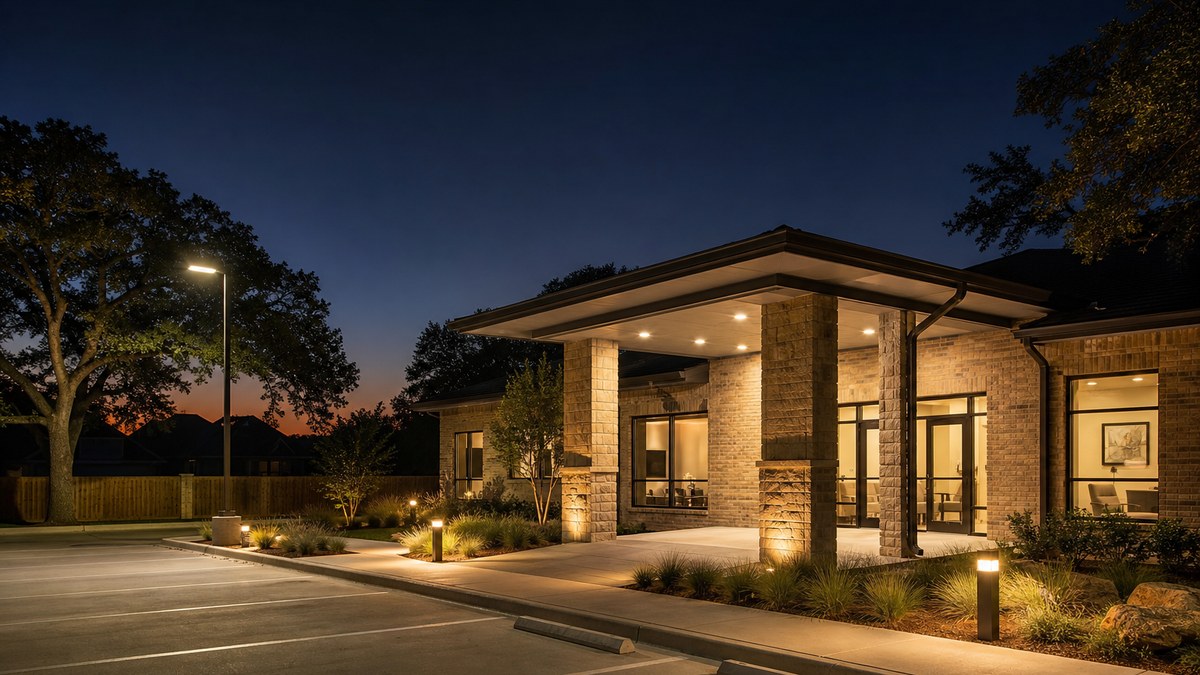
- Medical and professional offices: low-glare, high color-rendering interior lighting with occupancy sensors and dimming
- Schools and churches: durable LED fixtures with simple, reliable controls for classrooms, gyms, sanctuaries and fellowship halls; see our church lighting guide
- Exterior controls: photocells and schedules that turn lighting off or down late at night, which saves energy and keeps neighbors happy
Lighting that fits your city and your building
Tell us where your property is and what you need to light. We will check the local requirements, walk the site and prepare a project-specific proposal.
Alliance-area commercial lighting: scale, safety and uptime
The Alliance area is one of the largest concentrations of logistics and industrial space in Texas. According to Hillwood, AllianceTexas is home to 602 companies, directly supports 73,134 jobs and has seen 64.7 million square feet of office, retail and industrial space developed since 1989. Hillwood also notes the Texas Comptroller has recognized it as the primary inland port for the southwestern United States, and new speculative industrial buildings continued to break ground in 2026.
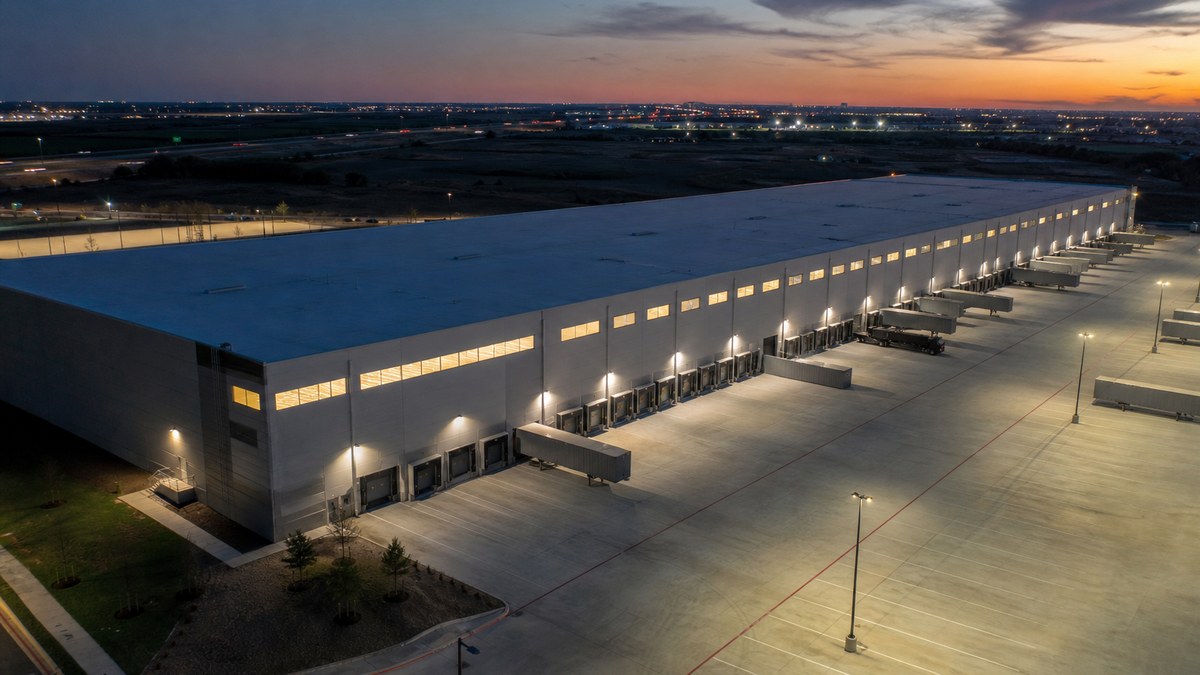
Buildings at that scale run on lighting. Pickers, forklift operators, maintenance crews, security teams and truck drivers all depend on it, often 24 hours a day. The priorities are different from a Southlake storefront:
- High-bay performance: LED high bays with the right optics for open storage, racking and narrow aisles, mounted to deliver uniform light on both floors and rack faces
- Sensors and controls: aisle and open-area occupancy control, daylight response near skylights and clerestories, and schedules; many of these are energy-code requirements in new construction and major alterations
- Loading docks and truck courts: dock lights, wall packs and pole lights that make backing, loading and yard moves safer at night
- Offices and break areas: comfortable office lighting inside the warehouse shell, with controls that follow the shift schedule
- Maintenance access: fixtures and controls that can be serviced without shutting down operations, since a dark aisle in a busy building is expensive
For the full warehouse playbook, including recommended light-level ranges and sensor strategies, read our warehouse LED lighting guide. For control strategies and energy-code details, see our commercial lighting controls guide.
Hotels, retail and offices around Alliance
Growth around the logistics core has brought hotels, restaurants, retail and office space to the Alliance area. These projects have the same goals as their counterparts in Southlake or Downtown Fort Worth: a welcoming arrival, comfortable interiors and efficient, code-compliant site lighting. See our hotel lighting guide and outdoor LED lighting guide for details, and our parking garage lighting guide for structured parking.
Building types we light across the corridor
| Building type | Key lighting goals | Typical LED solutions |
|---|---|---|
| Retail centers and storefronts | Visibility, inviting atmosphere, safe parking | Display and accent lighting, canopy downlights, shielded area lights, LED signage |
| Restaurants and patios | Mood, comfort, food presentation | Dimmable layered lighting, warm CCT, patio and landscape lighting |
| Corporate and professional offices | Comfort, low glare, productivity | Linear and troffer LED, daylight dimming, networked controls, PoE options |
| Medical offices and clinics | Accurate color, cleanability, calm spaces | High color-rendering fixtures, sealed fixtures where needed, tunable white |
| Warehouses and distribution centers | Uniform light, safety, energy control | High bays with aisle optics, occupancy sensors, dock and yard lighting |
| Hotels and hospitality | Arrival experience, guest comfort | Facade and canopy lighting, lobby layers, guestroom controls |
| Churches and schools | Flexible use, durability, simple control | Dimmable house lighting, gym high bays, exterior security lighting |
Exterior lighting that keeps the neighbors on your side
Across Southlake, Keller and the Alliance area, the single biggest source of lighting problems is exterior lighting. Unshielded wall packs, over-bright parking lots, glaring sign faces and lights left on all night create complaints, code issues and wasted energy. LED makes it much easier to get exterior lighting right, because the light can be directed precisely and dimmed or switched without warm-up delays.
A neighbor-friendly exterior lighting design usually includes:
- Fully shielded, downward-aimed fixtures that keep light below the horizontal and off neighboring properties
- House-side shields and the right optics on pole lights near property lines
- Warmer color temperatures where the city or the site calls for them, often around 3000K for exterior commercial lighting
- Uniform rather than extreme light levels, since even light reads as safer than bright hot spots next to dark shadows
- Automatic controls: off in daylight, and reduced or off late at night where the property allows, which the 2015 IECC also requires for many exterior applications
- A clear lighting plan with calculated light levels so city reviewers and owners know exactly what they are getting
We cover parking lots, facades, canopies and site lighting in depth in our Fort Worth outdoor LED lighting guide.
Interior lighting and controls: where efficiency is won
Interior lighting is where most of a commercial building's lighting energy is used, and it is where the energy code focuses most of its requirements. In properties covered by the 2015 IECC, that generally means occupant sensors in many enclosed spaces, time-switch controls, light-reduction controls, daylight-responsive controls in qualifying daylight zones, separate control for display and accent lighting, and functional testing before the job is closed out. Southlake and Keller projects follow the code editions those cities have adopted, so the details can differ.
The good news is that modern LED systems make these requirements easy to meet and often improve the space at the same time. Networked lighting controls and PoE lighting systems can add scheduling, scene control, occupancy data and remote monitoring for multi-tenant offices and corporate campuses. Codes and electrical licensing still apply to PoE and low-voltage systems, so they are designed and installed with the same care as line-voltage lighting.
Commercial properties may qualify for energy-efficiency incentives through Oncor programs, depending on the property's electric service and program availability. We can help you check whether a project is a candidate.
How a project runs: from site walk to switch-on
Whether it is one retail suite in Keller or a full distribution building near Alliance, our process follows the same steps. For more detail, see our LED light installation guide.
- Discovery call. We learn what you are lighting, your goals, schedule and any landlord, tenant or brand standards.
- Jurisdiction and code check. We confirm which city issues the permit and which lighting, sign and energy-code requirements apply.
- Site walk. We review existing fixtures, circuits, controls, mounting heights, ceiling conditions and site constraints, and look at exterior lighting after dark when it matters.
- Lighting design. We select fixtures, optics, color temperatures and controls, and prepare photometric layouts and lighting plans where the project needs them.
- Project-specific proposal. You receive a clear scope covering fixtures, controls, installation, permits and schedule.
- Permits and coordination. We coordinate with the general contractor, the city and other trades so lighting fits the construction schedule.
- Installation. Licensed electricians install fixtures and controls, often in phases or after hours to keep businesses open.
- Programming and testing. Sensors, schedules, daylight controls and scenes are set up and verified, including the functional testing the energy code calls for.
- Handover and service. You get documentation, control settings and a point of contact for service. See our repair and service options.
Retrofit or new construction?
Many properties in Southlake and Keller were built with metal halide parking lot lights, fluorescent troffers and halogen accent lighting. Many older Alliance buildings started with metal halide or fluorescent high bays. Replacing those systems with LED is usually the fastest way to improve light quality and cut maintenance. Retrofits can range from simple fixture swaps to full redesigns with new layouts and controls, and alterations can trigger energy-code requirements, so scope matters.
New construction and tenant finish-out projects are a chance to get everything right from the start: lighting layout, controls, exterior photometrics and signage all designed together and approved once. If you are building in the area, bring lighting into the conversation during design development instead of after the electrical drawings are done.
| Question | Retrofit | New construction / finish-out |
|---|---|---|
| Main goal | Better light, less maintenance, lower energy use | Code-compliant design that fits the brand and use |
| Code impact | Depends on scope; alterations can trigger control requirements | Full energy-code and lighting-plan review |
| Disruption | Phased or after-hours work to keep the business open | Coordinated with the construction schedule |
| Controls | Fixture-integrated sensors or wireless controls are common | Wired, wireless or networked systems designed in |
| Pricing | Project-specific proposal after a site walk and plan review | |
Why work with Fort Worth LED Lights
We focus on commercial, architectural and outdoor LED lighting in Fort Worth and Tarrant County. Our team brings 15+ years as an authorized architectural lighting dealer and project coordinator. Our licensed installation partner has completed over 200 major sports and commercial projects across the US and Canada — NFL, NBA, NHL, MLS, NCAA and NASCAR.
For you, that means one team that can handle design, fixtures, controls, installation coordination and service, whether the project is a storefront, an office suite, a church campus or a distribution building. We also handle LED video walls, LED signage, architectural and facade lighting and design-build work through our Luminance program. Learn more about our services and the areas we serve.
Areas we serve in northeast Tarrant County
We work throughout Southlake, Keller and the Alliance area, as well as the surrounding communities of north Fort Worth, Roanoke, Westlake, Haslet, Grapevine and Colleyville, and across the rest of Fort Worth and Tarrant County, including Downtown, Near Southside, West 7th, the Stockyards, Clearfork and Arlington. If you are not sure whether your property is in our area, send us the address.
Frequently Asked Questions
Do you provide commercial lighting services in Southlake, Keller and Alliance?
Does Southlake have an outdoor lighting ordinance?
Are there lighting rules for commercial buildings in Keller?
Is Alliance in Fort Worth?
What energy code applies to commercial lighting in this area?
How much does commercial LED lighting cost in Southlake or Keller?
Can you light a warehouse or distribution center near Alliance?
How do you keep exterior lighting from bothering neighbors?
Do you handle permits and lighting plans?
Are there incentives for LED upgrades in northeast Tarrant County?
Better light for Southlake, Keller & Alliance
Request a site walk and we will review your property, the local requirements and your goals, then prepare a project-specific proposal.
Related
Our DFW lighting network: Dallas commercial LED lighting, Arlington LED lighting, Irving LED lighting, Plano LED lighting, statewide Texas LED lighting, wholesale LED components, fiber optic starlight ceilings, 360° fiber optic lighting, American LED signage, modular building solutions, and Dallas modular structures.