Warehouse LED Lighting in Fort Worth: The Guide for Distribution Centers, Alliance & I-35W Logistics
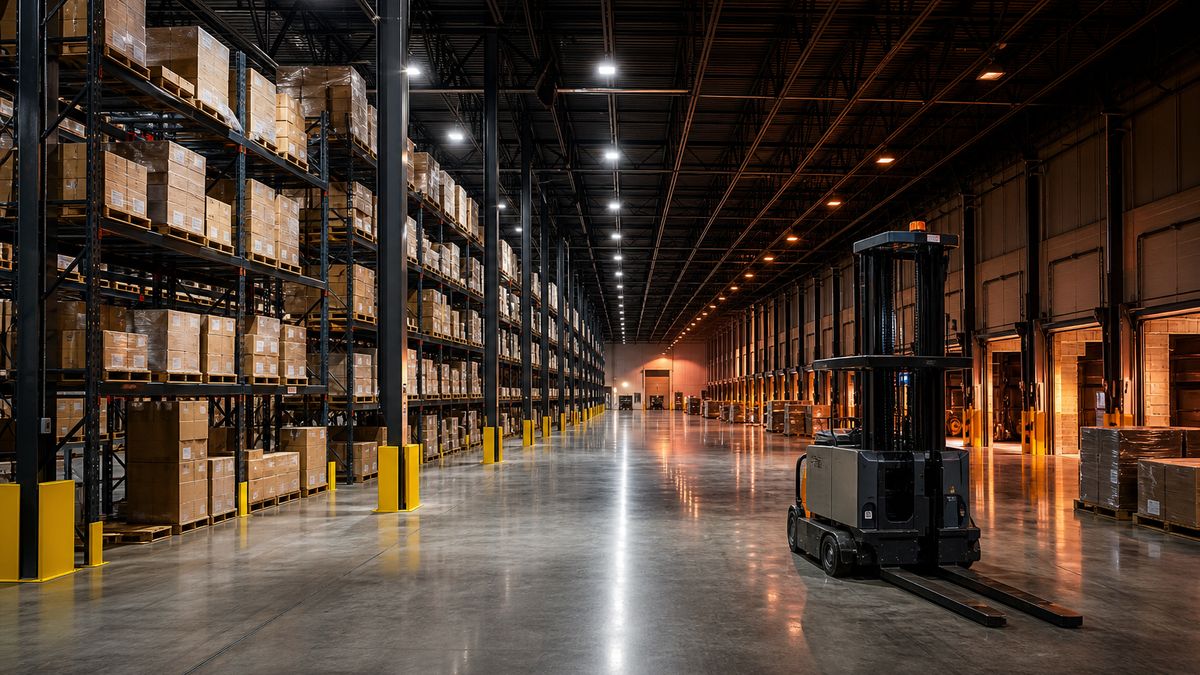
Warehouse LED lighting in Fort Worth has become a core piece of building infrastructure, not an afterthought. North Fort Worth is one of the busiest logistics markets in the country, and the buildings going up around AllianceTexas, the I-35W corridor and the I-20 and Loop 820 industrial parks are taller, deeper and busier than the warehouses of even ten years ago. Every one of them depends on lighting that lets people pick, pack, load and drive forklifts safely, around the clock, in a space that can be hotter than 100°F in August.
This guide explains how commercial warehouse and distribution center lighting works today: how much light different zones need, how to choose LED high bays for tall clear heights, why aisle layout matters more than fixture count, how lighting controls and the energy code apply in Fort Worth, how to handle loading docks, truck courts and cold storage, and how to plan a retrofit without slowing down operations.
Whether you manage a big-box fulfillment building in the Alliance Logistics District, a cross-dock along I-35W, a manufacturing plant in east Fort Worth, a flex-industrial suite in Haltom City or a parts warehouse off I-20, the goal is the same: the right light, on the right surfaces, only when and where it is needed, from equipment that keeps working in Texas heat.
Good warehouse LED lighting in Fort Worth comes down to seven decisions:
- Light levels by zone: storage, picking, packing, docks and offices each need different levels, set out in IES recommendations
- Fixture type: LED high bays or linear high bays sized for the clear height (often 32–40 ft in new Alliance buildings)
- Optics and layout: narrow aisle optics centered over aisles when racking runs close to the ceiling
- Controls: occupancy sensors, daylight sensors and scheduling, which Fort Worth's adopted energy code requires in many cases
- Heat rating: drivers and fixtures rated for the high ambient temperatures under an uninsulated Texas roof
- Docks and yards: dock lights, wall packs and truck-court area lights for safe night operations
- Pricing: quoted per building after a site walk and photometric layout
Why warehouse lighting matters in Fort Worth
Fort Worth's industrial base has grown around three things: highways, rail and air cargo. AllianceTexas in far north Fort Worth combines Perot Field Fort Worth Alliance Airport, the BNSF Alliance Intermodal Facility and millions of square feet of distribution space. In July 2026, developer Hillwood broke ground on Alliance Westport 16, a speculative building of roughly 1.2 million square feet with a 40-foot clear height and a 620-foot building depth, part of a larger pipeline of industrial space under construction or in design in the area. Buildings at that scale change what lighting has to do.
- Safety: forklifts, order pickers and reach trucks share aisles with people on foot. Clear, uniform light without dark patches or blinding glare reduces collisions, trips and picking errors.
- Accuracy: pickers read labels, barcodes and small print on cartons on the top and bottom shelves. Vertical light on rack faces matters as much as light on the floor.
- Operating hours: many distribution centers run two or three shifts. Lights that burn 18 to 24 hours a day make efficiency and controls a major operating line.
- Leasing and tenant fit: landlords marketing speculative buildings and tenants fitting out a new lease both need lighting that matches the actual racking plan, not a generic grid.
- Maintenance access: every fixture at 35 or 40 feet means a lift, a closed aisle and lost productivity when it fails. Long-life LED and reliable drivers keep those visits rare.
How much light does a warehouse need?
There is no single number. The Illuminating Engineering Society (IES) publishes recommended light levels for different tasks, and a well-designed warehouse uses different levels in different zones. As a general reference, a Bonneville Power Administration lighting guide for large-volume spaces cites IES recommendations of roughly 10 to 30 footcandles horizontal and 5 to 15 footcandles vertical for warehouse storage areas. Active picking, packing, inspection and assembly areas typically need more, and offices, break rooms and restrooms follow their own recommendations.
| Warehouse zone | What the lighting needs to do | Design focus |
|---|---|---|
| Bulk and pallet storage | Safe travel, locating pallets and aisles | Uniform floor light, controls to dim when empty |
| Racking aisles (picking) | Read labels from floor to top beam | Vertical light on rack faces, narrow aisle optics |
| Pack-out and shipping | Detailed work at tables and stations | Higher levels, good color rendering, low glare |
| Receiving and staging | Inspect inbound freight, check paperwork | Even light across open floor, task light where needed |
| Loading dock doors | Load and unload trailers safely | Dock lights that reach into trailers, door-area lighting |
| Truck court and yard | Drivers, spotters and security at night | Area lights and wall packs, glare control, scheduling |
| Offices and break rooms | Computer work, meetings, rest | Comfortable office lighting and dimming |
Two practical points come up on almost every project. First, light levels are measured after the racking is installed, not in an empty shell, because tall racking blocks and shapes light. Second, more light is not automatically better. Over-lighting wastes energy, increases glare from shiny floors and shrink-wrap, and can make the transition to darker docks and yards harder for drivers' eyes.
Federal safety rules also touch lighting. OSHA's powered industrial truck standard (29 CFR 1910.178(h)) requires auxiliary directional lighting on forklifts where general lighting is less than 2 lumens per square foot. A properly lit warehouse should comfortably exceed that, but the rule is a reminder that lighting and forklift safety are connected.
LED high bays for tall clear heights
The main fixture in most warehouses is the LED high bay, either a round (UFO-style) fixture or a linear high bay. Both replace the metal halide and fluorescent T5 fixtures found in older buildings, and both turn on instantly, dim smoothly and work with sensors.
Round high bays
Round high bays are compact and powerful, which makes them a common choice for very tall open storage areas and manufacturing floors. They work well where light needs to be thrown a long way down to the floor.
Linear high bays
Linear high bays spread light along their length, which suits long racking aisles. With the right optics, a row of linear fixtures can light both rack faces evenly from the top beam down to the floor.
Matching optics to the space
Optics matter more than wattage. Wide distributions suit open floors and staging areas. Narrow aisle optics push light down between tall racks and onto the rack faces. If a building has 40-foot clear height and racking that runs close to the ceiling, fixtures generally need to be centered over the aisles, not spread on a uniform grid. Lower racking gives the designer more flexibility. That is why a lighting layout should always follow the racking plan.
Other specifications to check
- Color temperature: most warehouses use 4000K or 5000K for crisp, neutral light. Keeping one color temperature across the building looks consistent.
- Color rendering: standard high bays often have modest color rendering. Areas where people inspect products, match colors or read color-coded labels may need higher CRI fixtures.
- Glare control: lenses, reflectors and diffusers reduce glare for forklift drivers looking up at upper racking positions.
- Mounting and safety: safety cables, secure hangers and correct mounting heights matter in buildings with vibration from equipment and dock traffic.
- Listing: fixtures listed by the DesignLights Consortium (DLC) are typically required to qualify for utility incentive programs.
Layout: why the racking plan comes first
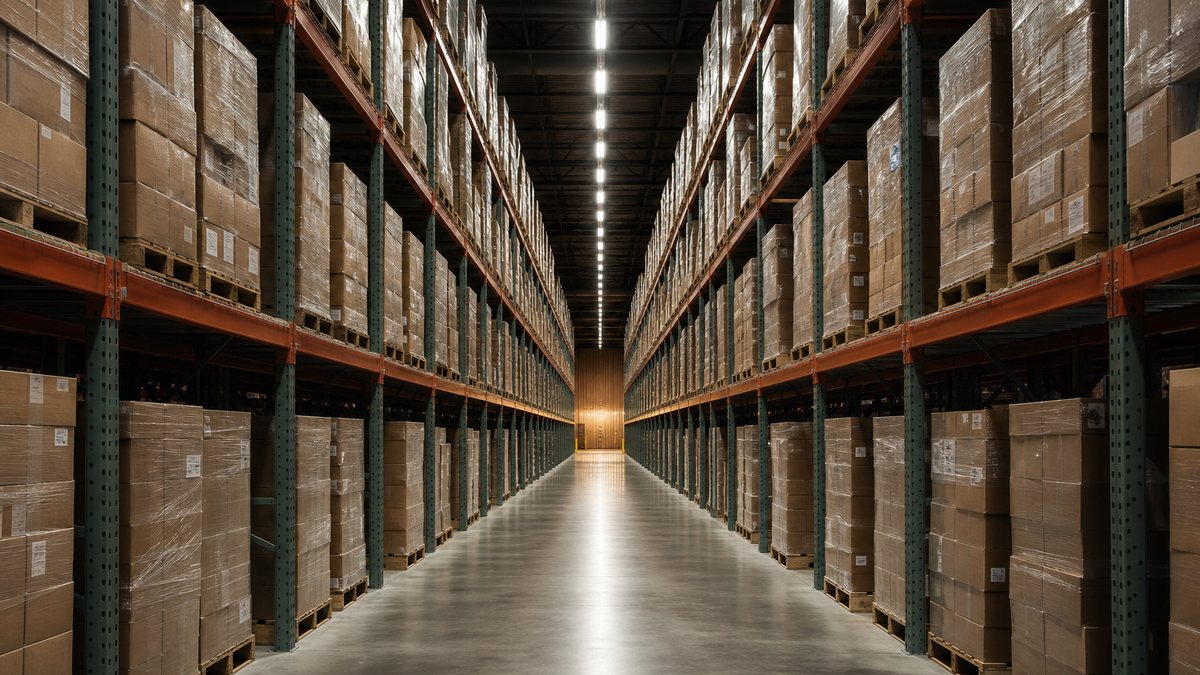
The most common mistake in warehouse lighting is a one-for-one swap: removing each old fixture and hanging a new LED in the same spot. Old fixture locations were often chosen for a different racking layout, or for an empty building. When tenants change, racking moves, and a fixture that once sat over an aisle can end up directly above a rack, lighting the top pallets and leaving the aisle in shadow.
A proper design starts with the current racking plan, the clear height, the aisle widths, the reflectance of the floor and ceiling, and how each area is used. A photometric layout then models horizontal and vertical light levels and uniformity before anything is ordered. This step often shows that a building can be lit better with fewer, better-placed fixtures, or that some aisles need more light while open storage needs less.
Planning ahead for change also helps. Fixtures on cord-and-plug connections or flexible whips, and controls that can be regrouped in software, make it far easier to move lighting when a tenant re-racks or a new lease begins.
Lighting controls and the Fort Worth energy code
Warehouses are ideal for lighting controls because many areas sit empty for long stretches. A forklift may visit a deep storage aisle a few times an hour. With occupancy sensors, the aisle can idle at a low level and brighten instantly when a forklift or person enters.
Controls are also a code issue. The City of Fort Worth uses the 2015 International Energy Conservation Code (IECC) with local amendments, with ASHRAE 90.1 as an alternative compliance path. The 2015 IECC includes specific occupant sensor requirements for warehouses: lighting in warehouse aisleways and open areas must be controlled by occupant sensors that automatically reduce lighting power when the area is unoccupied. Daylight-responsive controls can also be required where skylights or windows create daylight zones. Your design team and the city's plan review confirm exactly which requirements apply to a given project, but new construction, tenant finish-outs and many major lighting alterations should plan for controls from the start.
- Occupancy sensors: fixture-mounted sensors designed for high-bay mounting heights detect forklifts and people and dim or turn off unused areas. Not every sensor works at 35 to 40 feet, so sensor choice matters.
- Daylight harvesting: photosensors dim fixtures near skylights, clerestory windows and open dock doors when daylight is available.
- Scheduling: time schedules match lighting to shifts, weekends and holidays.
- High-end trim: setting maximum output to the level actually needed avoids over-lighting new installations.
- Networked controls: wireless or wired networked systems let facility teams regroup zones when racking changes, monitor energy use and spot failed fixtures without walking the floor.
Some owners also consider Power over Ethernet (PoE) lighting for offices and data-heavy spaces inside industrial buildings. Our guide to PoE lighting systems explains where that approach fits. Electrical codes and licensing still apply to any lighting system, including PoE. Fort Worth adopted the 2026 National Electrical Code effective September 1, 2026, and electrical work is performed by contractors licensed through the Texas Department of Licensing and Regulation (TDLR).
Planning a warehouse upgrade or fit-out?
Send us your racking plan, clear height and hours of operation. We will walk the building and prepare a project-specific proposal.
Heat, dust and Texas warehouse conditions
Many North Texas warehouses are not air-conditioned, and the air just under the roof deck can be far hotter than at floor level during summer. Heat is the main enemy of LED drivers and electronics, so product selection matters.
| Condition | What to specify |
|---|---|
| High ceiling temperatures | Fixtures and drivers rated for high ambient temperatures, good heat sinking, sensors rated for the same conditions |
| Dust and debris | Sealed or dust-resistant fixtures in dusty processes, lenses that are easy to clean |
| Washdown or humid areas | Wet-location or appropriately rated fixtures with sealed connections |
| Cold storage and freezers | Fixtures rated for low temperatures, sealed housings, sensors that work in the cold |
| Vibration from equipment | Secure mounts, safety cables, robust hangers |
| Storms and surges | Surge protection at fixtures and panels, especially for exterior fixtures |
Cold storage deserves special mention. Food distribution and temperature-controlled warehouses are a growing part of the DFW market. LED works very well in the cold, but fixtures, drivers and sensors must be rated for those temperatures and for condensation where doors open between cold and warm zones.
Loading docks, truck courts and the building exterior
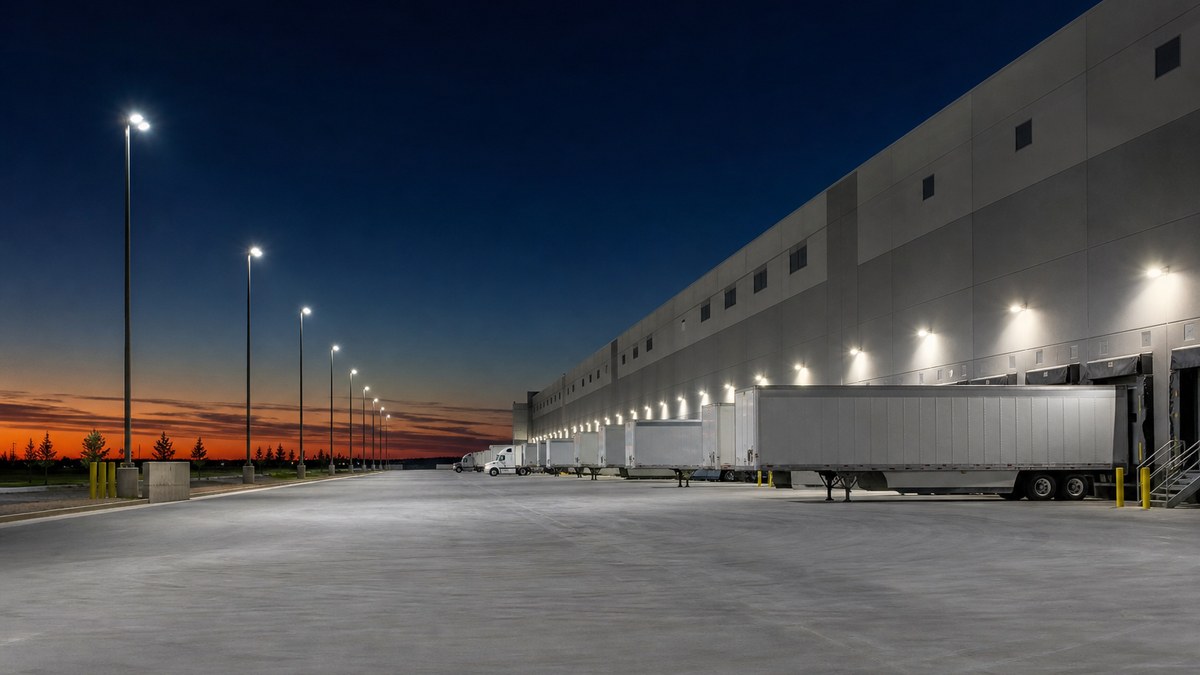
The dock is where indoor and outdoor lighting meet, and it is one of the highest-risk areas in any distribution center. Trailers are dark inside, forklifts move quickly between bright docks and dim trailers, and drivers back in at night.
- Dock lights: articulating LED dock lights reach into trailers so crews can see freight and floor conditions.
- Dock door area: fixtures inside the building at each door light the leveler and staging lane.
- Exterior wall packs: wall packs above dock doors light the apron and trailer positions.
- Truck courts and trailer parking: pole-mounted LED area lights provide uniform light across wide truck courts and trailer parking without glare in drivers' mirrors.
- Perimeter and security: lighting at gates, guard shacks, employee parking and walkways supports security cameras and safe shift changes.
Exterior lighting runs every night, so photocells, astronomical time clocks and late-night dimming deliver steady savings. Our Fort Worth outdoor LED lighting guide covers truck courts, parking lots and site lighting in more detail.
Retrofit or new installation?
Retrofits in existing buildings
Many older warehouses across Fort Worth still run metal halide or fluorescent high bays. A retrofit replaces those fixtures with LED and adds controls. Depending on the condition of the existing circuits, a retrofit can reuse much of the wiring, which keeps disruption low. It is also the right time to correct the layout if racking has changed since the original lights went in.
New construction and tenant fit-outs
Speculative buildings are often delivered with a basic lighting package or a lighting allowance. When a tenant signs a lease, the racking plan, operations and shift schedule are finally known, and the lighting can be designed to match. Bringing lighting into the conversation early, alongside the racking vendor and electrical contractor, avoids paying to move fixtures later.
Phased upgrades
Large buildings can be upgraded in phases, zone by zone, to spread the work and keep aisles open. Some owners start with the highest-hour areas, such as picking aisles and docks, then continue with storage and exterior lighting.
Installing lighting without stopping operations
A distribution center cannot simply close for a lighting project. Good planning keeps freight moving:
- Site walk. We review the building, racking, clear height, existing fixtures, circuits, controls and operating hours.
- Photometric design. Fixture selection, layout and controls are modeled for each zone.
- Proposal. A clear scope with a project-specific price, schedule and phasing plan.
- Scheduling. Work is planned around shifts, peak seasons and dock schedules, often at night or on weekends, aisle by aisle.
- Lift and safety plan. Scissor lifts and boom lifts are coordinated with forklift traffic, with barricaded work zones.
- Installation. Old fixtures removed and recycled, new fixtures hung and wired, sensors placed and aimed.
- Commissioning. Controls programmed, sensor time delays and dim levels tuned, light levels checked against the design.
- Handover. Zone maps, control settings and warranty documents provided to the facility team.
Our LED light installation guide walks through each step of a commercial installation from site walk to switch-on.
Common warehouse lighting mistakes
- Swapping fixtures one-for-one. The old layout may not match today's racking. A new photometric layout usually pays off in better light.
- Ignoring vertical light. Floor readings can look fine while upper rack labels sit in shadow.
- Picking sensors that cannot see the floor. Sensors must be rated for the actual mounting height.
- Setting time delays too short. Lights dimming while someone is still picking frustrates workers, who then ask for sensors to be disabled.
- Underestimating heat. Drivers rated only for mild conditions fail early under a hot Texas roof.
- Forgetting the docks and yard. Interior upgrades that leave dim docks and dark truck courts leave the riskiest areas untouched.
- Mixing color temperatures. Partial upgrades with different color temperatures look patchy and make inspection harder.
Energy savings and Oncor incentives
Replacing metal halide and fluorescent high bays with LED generally reduces lighting energy substantially, and adding occupancy sensors and dimming in aisles that sit empty much of the time increases savings further. Lower heat from LED can also reduce the load on cooling systems in conditioned spaces. Long LED life cuts the maintenance cost of lift-access work at high ceilings.
Many commercial LED projects in the Oncor service area may qualify for energy-efficiency incentive programs, such as Oncor's Commercial Standard Offer Program, depending on the project and current program availability. Program rules typically require DLC- or ENERGY STAR-certified products and lighting that meets IES recommended light levels, and incentives are usually submitted through participating service providers. We can help you understand what documentation a project may need. We do not quote incentive amounts in advance because they depend on the program, the project and funding at the time.
Warehouse lighting by facility type
Big-box distribution and fulfillment centers
Very large floor plates, tall clear heights, many dock doors and multiple shifts. Lighting is designed around racking, conveyors and pick modules, with networked controls for zoning.
Cross-dock and freight terminals
Long, narrow buildings with dock doors on both sides. The focus is on dock lighting, open floor uniformity and exterior truck courts.
Manufacturing plants
Production lines, assembly areas and inspection stations need higher light levels and better color rendering than storage areas.
Cold storage
Cold-rated fixtures and sensors, sealed housings and careful planning at transitions between cold and ambient zones.
Flex industrial and small-bay buildings
Smaller suites across Haltom City, Saginaw, east Fort Worth and the south side combine warehouse space with offices and showrooms, so lighting needs to work for both.
Parts, retail and e-commerce warehouses
Small items, frequent picks and detailed labels make vertical light and glare control especially important.
Areas we serve across the Fort Worth industrial market
We work with warehouses, distribution centers and industrial buildings across Fort Worth and Tarrant County, including the Alliance corridor and Haslet, Roanoke and Northlake, the I-35W and Loop 820 industrial parks, Meacham Field and the north side, east Fort Worth along I-30 and I-20, the south side near I-35W and Everman, Saginaw, Haltom City, Keller and Southlake, Arlington and Grapevine. See our service areas for more.
Why choose Fort Worth LED Lights
We handle warehouse lighting from the first walk-through to ongoing service: racking-based photometric design, commercial-grade LED high bays and dock lights, controls design and commissioning, installation planned around your operation, and repair and maintenance. Our team brings 15+ years as an authorized architectural lighting dealer and project coordinator. Our licensed installation partner has completed over 200 major sports and commercial projects across the US and Canada — NFL, NBA, NHL, MLS, NCAA and NASCAR. Learn more about our commercial lighting services, our repair and service work, and the Luminance design-build program. For a broader overview of interior retrofits, see our guide to commercial LED lighting services in Fort Worth.
Industrial owners often need more than lighting. Building signage and monument signs are covered in our LED signs guide, office lobbies and showrooms in our architectural lighting guide, and operations centers and lobbies with displays in our LED video walls guide. Our video wall services and signage services pages have more detail.
Frequently Asked Questions
What is the best LED lighting for a warehouse?
How many footcandles does a warehouse need?
Are occupancy sensors required in Fort Worth warehouses?
How much does warehouse LED lighting cost in Fort Worth?
Can you install warehouse lighting without shutting down operations?
Should I use round or linear LED high bays?
Do LED high bays work in hot, non air-conditioned warehouses?
Can LED lighting be used in cold storage and freezers?
Do warehouse LED upgrades qualify for Oncor incentives?
Do you light loading docks and truck courts too?
Let's light up your warehouse
Request a consultation and we will follow up to schedule a site walk of your building.
Related
Our DFW lighting network: Dallas commercial LED lighting, Arlington LED lighting, Irving LED lighting, Plano LED lighting, statewide Texas LED lighting, wholesale LED components, fiber optic starlight ceilings, 360° fiber optic lighting, American LED Signage, modular building solutions for on-site offices and guard buildings, and Dallas modular structures. Questions? Visit our blog or services.