Church Lighting in Fort Worth: The LED Guide for Sanctuaries, Stages, Livestreams & Campuses
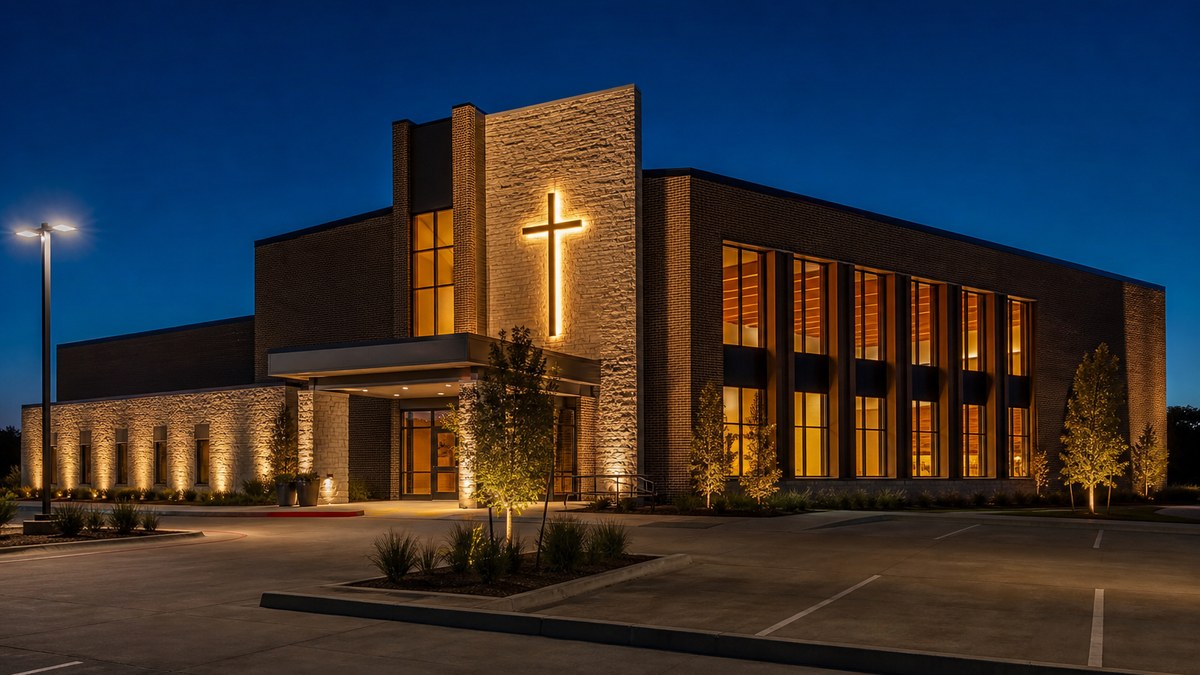
Church lighting in Fort Worth has a harder job than lighting in almost any other building type. In a single week the same sanctuary may host a quiet early service, a full worship set with a band, a wedding, a funeral, a children's program, a concert and a livestream watched by people who will never walk through the doors. The lighting has to support all of it: reverent and warm one moment, bright and energetic the next, and always flattering on camera.
At the same time, many congregations across Tarrant County are still running a mix of aging incandescent house lights, old halogen stage fixtures, fluorescent fellowship halls and orange high-pressure sodium parking lot lights. Those systems are expensive to keep running, hard to dim smoothly, hot under the stage, and difficult to match on video. Replacement lamps for some older fixtures are getting harder to find.
This guide walks church leaders, facilities teams, technical directors and building committees through every part of a modern LED lighting plan: the sanctuary and house lights, stage and worship lighting, livestream and video lighting, architectural lighting for historic and modern buildings, fellowship halls, classrooms and children's wings, and the parking lots and grounds where every visit begins and ends. It also covers controls, energy code, safety, phasing and how to plan an upgrade without disrupting your calendar. This post focuses on lighting; for screens and displays, see our separate guide to LED video walls in Fort Worth.
A complete church lighting system in Fort Worth usually includes:
- House lights: dimmable LED fixtures that fade smoothly to very low levels without flicker
- Stage and platform lighting: front light from both sides, backlight, and color washes for worship
- Video and livestream lighting: consistent color temperature and high color rendering so faces look natural on camera
- Architectural lighting: facade, steeple, window and cross lighting that makes the building visible at night
- Campus lighting: fellowship halls, classrooms, children's areas, corridors and offices
- Site lighting: parking lots, walkways, entrances and drop-off canopies
- Controls: presets for each type of service, easy wall stations for volunteers, and integration with the lighting console
- Pricing: a project-specific proposal after a site walk-through
Why church lighting is different
Most commercial buildings need light that is efficient, uniform and comfortable. Churches need all of that, plus light that serves worship. A few things make houses of worship unique:
- Many uses in one room. The sanctuary is a worship space, a concert hall, a lecture room, a wedding venue and a broadcast studio. Lighting needs presets that switch between those modes in seconds.
- Volunteers run the system. Most churches depend on volunteers at the console and the wall switches. A system that only one person understands becomes a weekly problem.
- High ceilings and hard access. Vaulted sanctuaries, exposed trusses and catwalk-free ceilings make every lamp change a lift rental. Long-life LED cuts that burden dramatically.
- Cameras are always watching. Even small congregations now stream services. Cameras see flicker, mixed color temperatures and harsh shadows far more clearly than people do.
- Buildings carry meaning. Stained glass, carved wood, stone, a cross, a baptistry or a historic facade all deserve light that respects them.
- Budgets are stewarded carefully. Congregations want to know that every dollar spent on lighting brings lasting value, which is why phasing and clear scopes matter.
Sanctuary house lighting
House lights are the general lighting over the congregation. They are often the most overlooked part of a church lighting system, yet they affect every person in every service. Good LED house lighting should deliver:
- Smooth, deep dimming. Fades from full to a soft glow and back without stepping, popping or flicker. Low-end dimming performance varies widely between products, so it should be tested before you commit to a fixture.
- Even coverage. Every row should be able to read a bulletin or a Bible, including the balcony and the back corners under overhangs.
- A warm, welcoming tone. Many sanctuaries use warmer color temperatures for house lighting, while the stage is lit to match the cameras.
- Glare control. Downlights and pendants should not shine into the eyes of people looking toward the platform, or into camera lenses.
- Respect for the architecture. In traditional sanctuaries, existing chandeliers and pendants can often be retrofitted with LED rather than replaced, keeping their character while improving output and dimming.
House lights also need to work with the stage. During worship many churches lower the house to focus attention on the platform, then raise it for announcements, scripture reading and fellowship. Those levels should be saved as presets, not set by hand each week.
Stage and worship lighting
Stage lighting is where the biggest changes have happened. Modern LED stage fixtures run cool, draw a fraction of the power of the old halogen instruments, and can produce white light in a range of color temperatures as well as saturated color, all from the same fixture. A solid platform lighting plan usually has three layers:
Front light
Front light lets the congregation and the cameras see faces. A common starting point in theatrical practice is to light each area of the platform from two sides, roughly 45 degrees up and 45 degrees out from the person on stage, so that light from the left and right fills each other's shadows. For close-up video, many designers bring that angle lower to soften shadows under the eyes and chin. The platform is typically divided into zones so the pastor, worship leader, choir and band can each be lit evenly as they move.
Backlight
Backlight comes from behind and above the people on stage. It separates them from the background, adds depth on camera, and gives the stage a finished, professional look. Too much front light washes out backlight, so the two have to be balanced together.
Color and texture
Color washes on the back wall, set pieces, curtains or a cyclorama create atmosphere for worship without distracting from the message. LED wash fixtures and linear fixtures make this practical: a single console cue can shift the room from a reflective blue to a warm amber. Moving lights and effects are optional layers that some churches add for larger productions and special seasons.
For a smaller chapel, the stage plan might be a handful of fixtures on a single pipe. For a large sanctuary it may include multiple front-of-house positions, truss, and a full console. The principles are the same; only the scale changes.
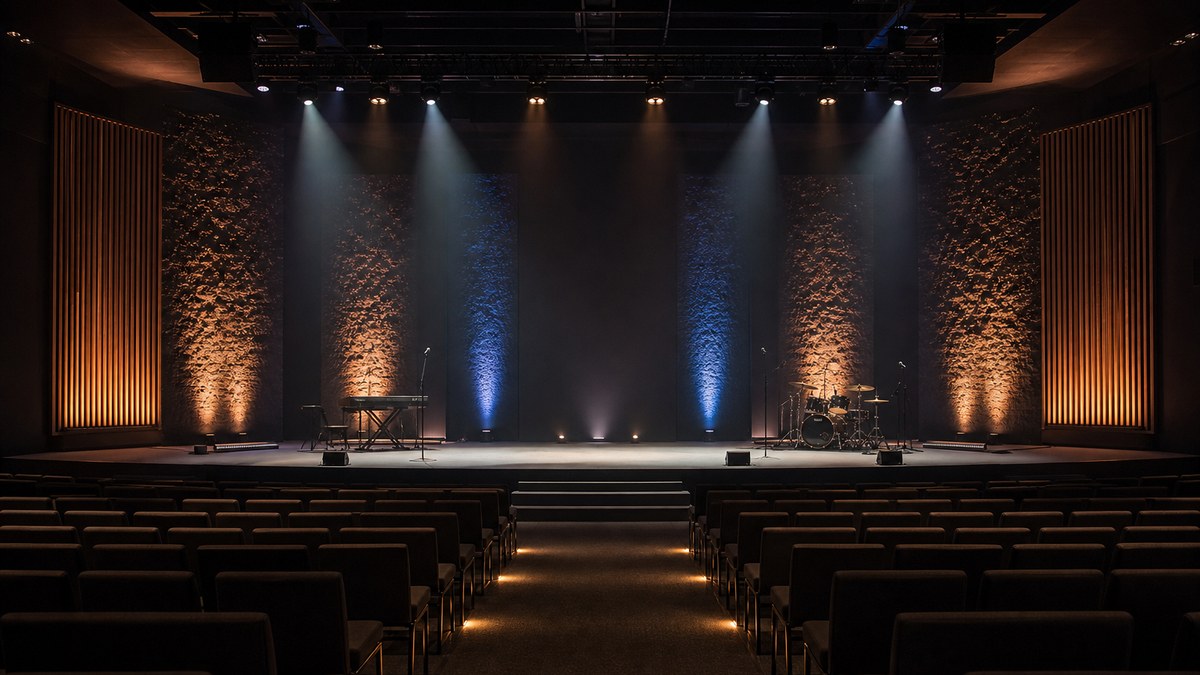
Lighting for livestream and video
For many congregations, the livestream is now the front door. People watch online before they ever visit in person, and members who are traveling, homebound or caring for family rely on it every week. What looks fine in the room can look flat, orange or harsh on a camera, so video needs its own planning:
- One color temperature on stage. Mixing older warm fixtures with newer cool ones makes skin tones shift as people move. Match every white light that reaches the platform.
- High color rendering. Fixtures with strong color rendering make skin, clothing and wood look natural. For broadcast work, many designers also look at television-specific color metrics.
- Flicker-free dimming. Some LED drivers flicker at certain dimming levels, which shows up as rolling bands on camera. Specify drivers and fixtures that stay flicker-free at the levels you actually use.
- Enough light, not too much. Cameras need adequate light on faces, but blasting the stage makes the room uncomfortable and washes out screens. The goal is balance between stage, house and screens.
- Control of the background. The back wall, choir and screens should sit slightly darker than faces so the camera exposes the people correctly.
- Consistency week to week. Saved presets mean the stream looks the same whether a staff member or a new volunteer is running lights.
It helps to involve your camera team in the design. Fixture positions should avoid shining into lenses, and the lighting plan should be checked through the actual cameras before the system is signed off.
Plan a sanctuary that looks right in the room and on camera
Tell us about your building, services and goals. We will walk the campus and prepare a project-specific proposal.
Choosing the right color temperature
Color temperature is one of the most important decisions in a church lighting project. Warmer light, around 2700K to 3000K, feels intimate and traditional and suits many sanctuaries, chapels and historic interiors. Neutral light, around 3500K to 4000K, feels crisp and clear and is common in classrooms, offices and fellowship halls. Stage white light is usually chosen to match the cameras, and tunable-white fixtures let the platform shift between warm and neutral for different services. These are typical design ranges, not rules; what matters most is choosing on purpose and staying consistent within each space.
| Space | Main goals | Typical LED approach |
|---|---|---|
| Sanctuary house | Warmth, readable light, deep dimming | Dimmable downlights, retrofitted pendants or chandeliers, cove lighting |
| Platform and stage | Faces visible in the room and on camera | Two-sided front light, backlight, color washes, console control |
| Choir and baptistry | Even light, no hot spots or glare | Soft front fill, low-glare accent lighting |
| Fellowship hall | Flexible for meals, meetings and events | Dimmable fixtures with scene presets |
| Classrooms and children's wing | Clear, comfortable, safe | Low-glare panels or troffers, occupancy sensors |
| Facade, steeple and cross | Visible landmark at night | Wall washing, grazing, uplighting, outdoor-rated controls |
| Parking and walkways | Safety and security | LED area lights, wall packs, scheduled dimming |
Architectural lighting for historic and modern churches
Fort Worth has an extraordinary range of church architecture, from stone and brick sanctuaries near Downtown and the historic neighborhoods to contemporary worship centers along the growing corridors north and west of the city. Exterior lighting tells the community that the church is alive and welcoming, even on a Tuesday night.
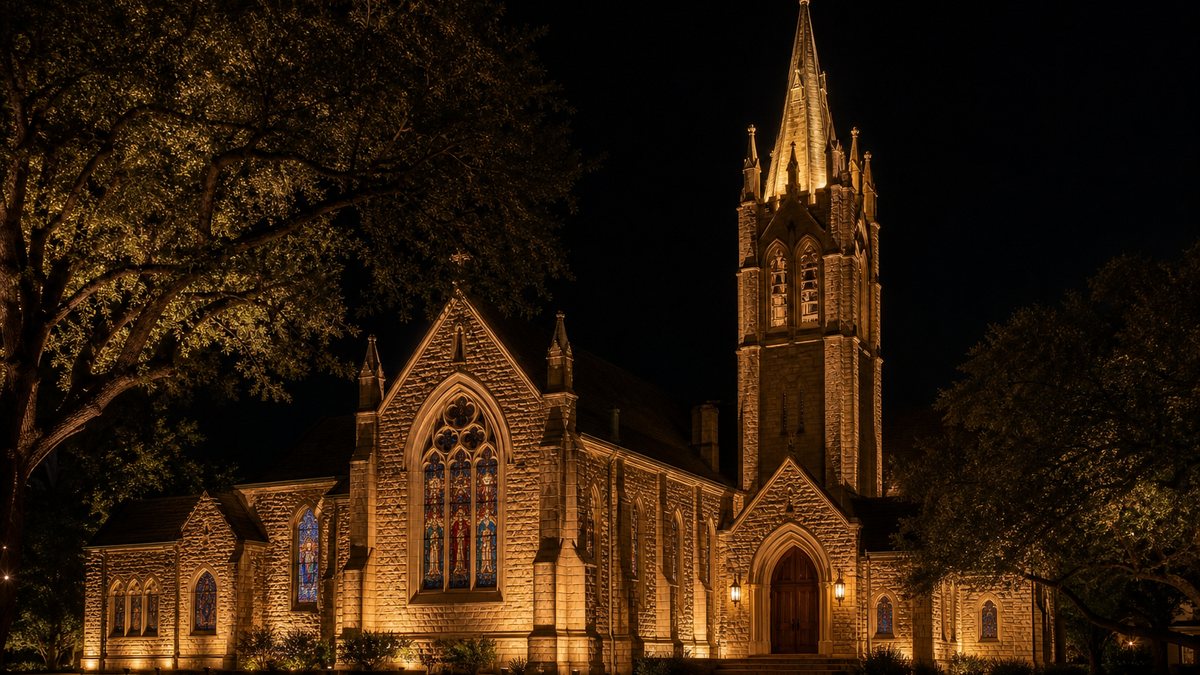
- Facade lighting: wall washing for broad surfaces, grazing to bring out the texture of stone and brick.
- Steeples and towers: carefully aimed uplighting makes the tower a landmark without spilling light into the sky.
- Crosses and signs: even, glare-free lighting so the symbol reads clearly from the street.
- Stained glass: interior lighting can make windows glow outward at night, while careful exterior lighting avoids washing them out.
- Entrances: warm, welcoming light at the doors where greeters meet guests.
Historic buildings need extra care. Fixtures should be mounted without damaging masonry, cable routes should be concealed, and the light should honor the original design. Our architectural LED lighting guide covers facade techniques in more depth, and our architectural lighting services include design, programming and repair of existing facade systems.
Fellowship halls, classrooms and children's areas
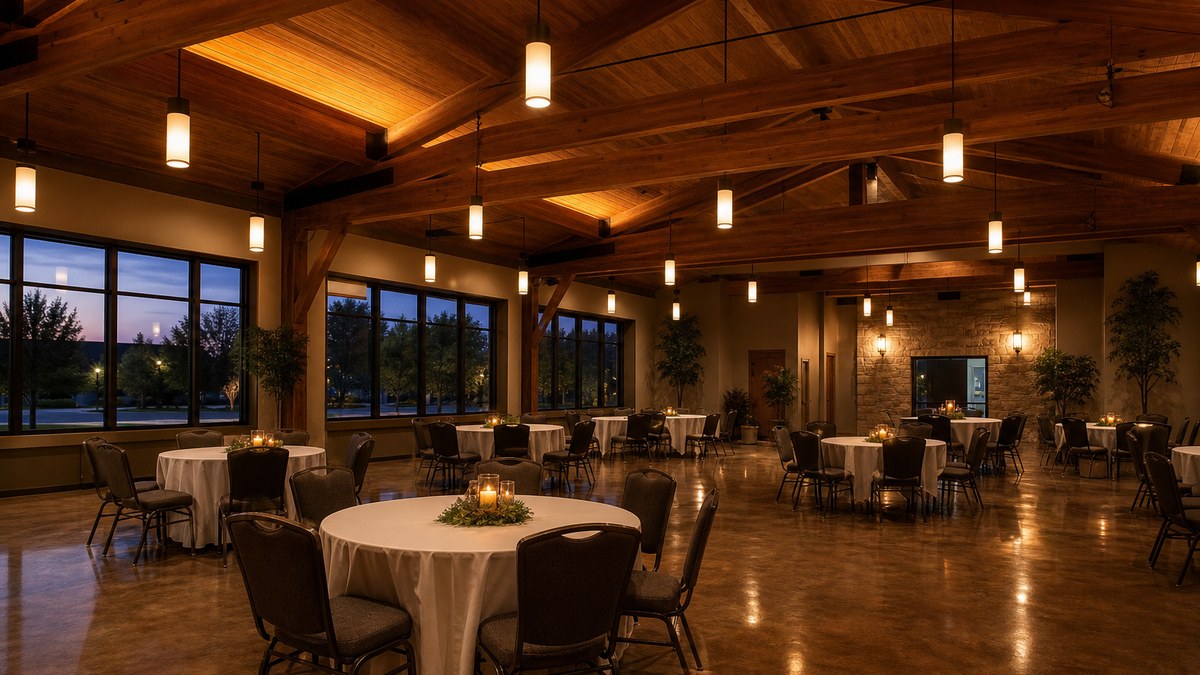
A church campus is much more than the sanctuary. Fellowship halls host meals, receptions, recovery groups and community events. Classrooms, nurseries and children's wings host the youngest members of the congregation. Offices, kitchens, corridors and restrooms keep everything running. These spaces benefit from the same upgrades that work in offices and schools:
- Fellowship halls: dimmable fixtures with simple scene buttons for dinner, meeting and event settings.
- Classrooms: low-glare LED panels that make reading and screens comfortable.
- Children's areas: bright, cheerful, well-shielded fixtures, plus good lighting at check-in desks and security doors.
- Corridors and restrooms: occupancy sensors so lights are not left on all week in empty wings.
- Kitchens: clear, even light on prep surfaces for volunteers preparing meals.
Many churches start with these spaces because the improvement is immediate and the work can be done during the week without touching Sunday services. Our commercial LED lighting services cover interior retrofits and new installations across the campus.
Parking lots, walkways and grounds
Evening services, youth nights, choir rehearsals and midweek groups mean people are walking to their cars after dark several nights a week. Dark lots, burned-out poles and dim walkways are a safety risk and leave a poor first impression. LED area lights, wall packs and pathway lighting deliver whiter, more uniform light with far less maintenance, and scheduled dimming keeps them from running at full output all night when the campus is empty. Covered drop-off canopies and accessible parking areas deserve particular attention. Our Fort Worth outdoor LED lighting guide covers lot and site lighting in detail, and for structured parking see our parking garage LED lighting guide.
Controls that volunteers can use
A lighting system is only as good as its controls. The best church systems are powerful for the technical director and simple for everyone else:
- Lighting console: for stage cues during worship and productions.
- Architectural control system: for house lights, aisles and room presets, tied to the console so both work together.
- Labeled wall stations: buttons such as "Pre-Service," "Worship," "Sermon," "Wedding" and "Clean-Up" so anyone can set the room correctly.
- Schedules and time clocks: exterior and campus lights that follow the church calendar and sunrise and sunset.
- Occupancy sensors: in classrooms, offices, restrooms and storage areas.
- Lockouts: protected settings so a stray button press cannot undo a carefully programmed preset.
Training is part of the job. A short volunteer guide and a walkthrough with your team help the system stay right long after installation. For buildings planning broader smart-building upgrades, our guide to PoE lighting systems explains how networked lighting can simplify control and monitoring.
Energy code, permits and safety in Fort Worth
Church lighting projects follow the same codes as other commercial buildings. The City of Fort Worth uses the 2015 International Energy Conservation Code with local amendments, with ASHRAE 90.1 as an alternative path, the 2021 International Building Code, Fire Code and Existing Building Code, and the 2026 National Electrical Code effective September 1, 2026. Electrical work is performed by electricians licensed through the Texas Department of Licensing and Regulation. Your design and installation team should confirm the specific requirements for your project with the city.
A few points matter most for churches:
- Theatrical and video lighting. The 2015 IECC lists theatrical, stage, film and video production lighting among the lighting excluded from the interior lighting power calculation. General house, classroom and hall lighting still has to meet the code's power and control requirements.
- Controls. Interior spaces generally need controls such as occupancy sensors, time switches or light reduction, and exterior lighting needs automatic dusk-to-dawn and scheduling controls.
- Emergency and egress lighting. Sanctuaries are assembly spaces, so aisles, exits and stairs need emergency lighting that works when the house lights are dimmed or power fails. Dimmed house presets should never leave egress paths dark.
- Rigging and structure. Stage fixtures, truss and pipes must be mounted to structure that is rated for the load, with safety cables on overhead fixtures.
- Heat and wiring. LED dramatically reduces heat compared with older stage lighting, but dimmer and power circuits still need to be designed for the new loads and controls.
Planning a church lighting upgrade
- Listening session. We meet with the pastor, technical director, facilities team and building committee to understand services, events, streaming and long-term plans.
- Site walk-through. We visit during a service or rehearsal when possible, and at night for exterior lighting, to see how the spaces are actually used.
- Existing system review. Fixtures, dimmers, circuits, controls, rigging points and access are documented.
- Design. Fixture selection, positions, color temperature, control presets and, where helpful, lighting calculations.
- Mock-ups. For house dimming and stage looks, a test fixture or two confirms the feel in the room and on camera before full purchase.
- Proposal. A clear scope, phasing plan and project-specific price that a committee can review.
- Installation. Scheduled around services, weddings, holidays and events, with lifts and crews coordinated for high ceilings.
- Programming and training. Presets built, cameras checked, and volunteers trained on the console and wall stations.
Our LED light installation guide explains the process from site walk to switch-on, and our Luminance design-build program handles complete lighting transformations from concept to commissioning.
Phasing around the church calendar
Few churches can close the sanctuary for weeks. A phased plan keeps ministry running:
- Weekday work: classrooms, offices, fellowship halls and parking lots can usually be upgraded without affecting weekend services.
- Sanctuary work between Sundays: house lighting and stage positions can be installed in planned weekday windows, with the room ready for the next service.
- Before key seasons: many churches aim to finish sanctuary work before Easter, Christmas or a major event, so planning should start early.
- Budget phases: infrastructure and controls first, then fixtures in stages, so each phase works on its own and nothing has to be redone later.
Common church lighting mistakes
- Buying fixtures one at a time. A mix of brands and color temperatures looks inconsistent on camera and is hard to control together.
- Ignoring the house lights. A great stage with poor house dimming still feels unfinished, and the jump between house and stage is obvious on video.
- Too much front light. Over-lit faces look flat, wash out backlight and make the platform uncomfortable for the people on it.
- Skipping dimming tests. Some LED products flicker or step at low levels. Test before you buy.
- Controls only one person understands. If the room cannot be set correctly when the technical director is away, the system needs simpler presets.
- Forgetting maintenance access. Fixtures placed where no lift can reach become a problem years later.
- Neglecting the grounds. A beautifully lit sanctuary does not help a guest who cannot find the entrance from a dark parking lot.
Energy savings, maintenance and incentives
Replacing incandescent, halogen, fluorescent and HID lighting with LED commonly reduces energy use substantially, and adding dimming, scheduling and occupancy controls increases savings further. Because LED stage fixtures run much cooler than older instruments, the platform is more comfortable for the people on it and the cooling system has less heat to remove during services. Long LED life also means far fewer lift rentals to change lamps in high sanctuary ceilings. Commercial LED lighting projects in the Oncor service area may qualify for energy-efficiency incentive programs, depending on the project and current program availability. Qualifying products such as DLC-listed fixtures are typically required, and incentives are usually arranged through participating service providers before work begins.
Why churches choose Fort Worth LED Lights
We coordinate church lighting projects from the first conversation to the final preset: campus walk-throughs, design, fixture selection, controls, installation by licensed electricians, programming and volunteer training. Our team brings 15+ years as an authorized architectural lighting dealer and project coordinator. Our licensed installation partner has completed over 200 major sports and commercial projects across the US and Canada — NFL, NBA, NHL, MLS, NCAA and NASCAR. We serve congregations across Fort Worth and Tarrant County; see our service areas and the full list of lighting services. For sign lighting and digital message centers, we work with American LED Signage, and you can read more in our LED signs guide. If your church also runs a hospitality ministry, cafe or event venue, our restaurant lighting and hotel lighting guides share ideas for dining and event spaces. When existing systems fail, our repair and service team can help.
Frequently Asked Questions
What is the best lighting for a church sanctuary?
How much does church lighting cost in Fort Worth?
What lighting do we need for church livestreaming?
Can our existing chandeliers and pendants be converted to LED?
What color temperature should church lighting be?
Can volunteers run a modern church lighting system?
Will the upgrade disrupt Sunday services?
Do church lighting projects qualify for incentives?
Can you light the outside of our church?
What areas do you serve?
Let's light up your church
Request a consultation and we will follow up to schedule a campus walk-through.
Related
Our DFW lighting network: Dallas commercial LED lighting, Arlington LED lighting, Irving LED lighting, Plano LED lighting, statewide Texas LED lighting, wholesale LED components, fiber optic starlight ceilings, 360° fiber optic lighting, premium pool lighting, modular building solutions, and Dallas modular structures.