Commercial Lighting Controls in Fort Worth: The Guide to Energy Code, Sensors, Daylight Dimming & Networked Controls
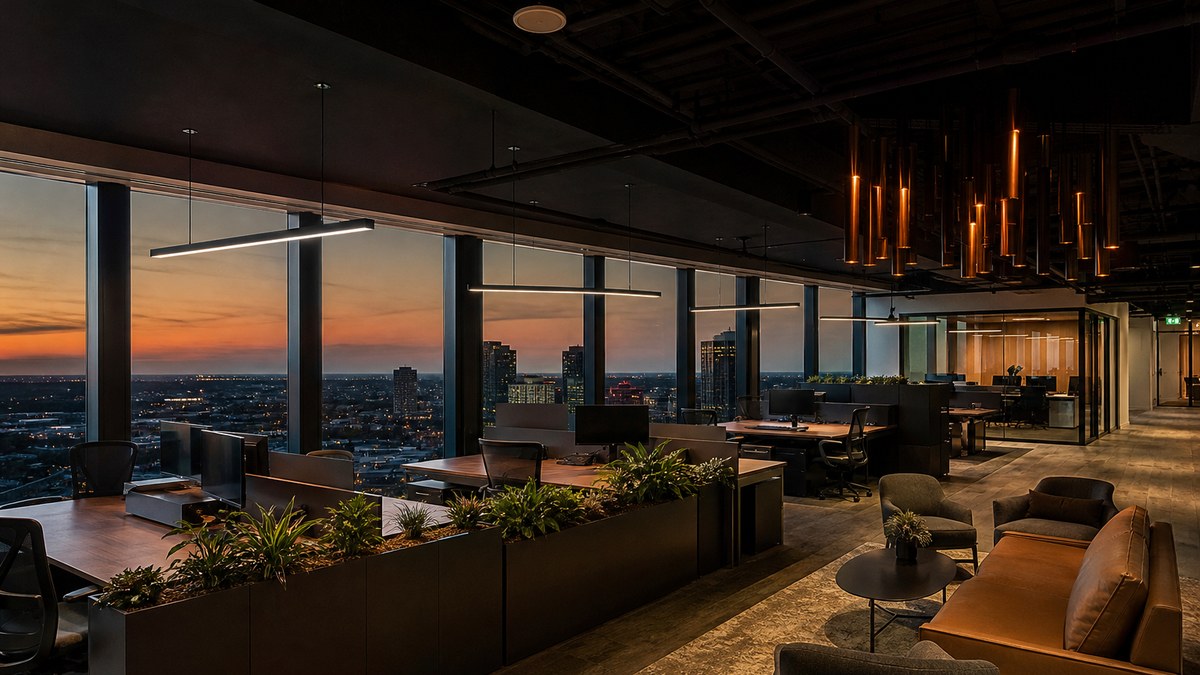
Commercial lighting controls in Fort Worth decide how much value you actually get from LED lighting. The fixtures set the quality of light, but the controls decide when lights come on, how bright they run, which areas stay dark when nobody is there and whether the building passes inspection under the city's energy code. A brand-new LED system wired to a single wall switch leaves energy savings, comfort and code compliance on the table.
Fort Worth's commercial building stock is wide: Downtown and Clearfork office towers, Alliance and I-35W distribution centers, Near Southside and West 7th restaurants, Stockyards retail, schools, churches, clinics, hotels and parking structures. Each building type needs a different control strategy, but they all answer to the same basic code framework, and they all benefit from controls that are designed, programmed and tested properly instead of simply installed.
This guide is written for building owners, facility and property managers, tenants planning a build-out, architects and contractors. It explains the lighting control requirements in the code Fort Worth has adopted, the main control strategies, how wired, wireless and networked systems compare, what controls look like in different building types, how retrofits differ from new construction and how to plan a project. For the fixture side of the conversation, see our commercial LED lighting services guide.
Good commercial lighting controls in Fort Worth usually include:
- Occupancy or vacancy sensors: lights turn off automatically within 30 minutes after a space empties, as the 2015 IECC requires in many space types
- Time scheduling: lights follow the building's hours, with a limited manual override
- Dimming or light reduction: occupants can lower general lighting by at least half
- Daylight-responsive control: fixtures near windows and skylights dim automatically when daylight is available
- Exterior controls: outdoor lights off in daylight and reduced or off late at night
- Separate control for display, accent and special-use lighting
- Functional testing: controls verified as calibrated and working before the job is closed out
- Pricing: a project-specific proposal after a site walk and review of your plans
Why lighting controls matter more than ever
When most commercial buildings used fluorescent, metal halide or high-pressure sodium lighting, controls were often an afterthought: lights were switched on in the morning and off at night, and many stayed on around the clock. LED changed that. LED fixtures turn on instantly, dim smoothly, tolerate frequent switching and can carry sensors directly in the fixture. That makes advanced control strategies practical in places where they used to be difficult.
Good controls deliver several benefits at once:
- Lower energy use. The cheapest light is the one that is off. Sensors, schedules and daylight dimming cut the hours and the power your lighting draws.
- Code compliance. New construction, additions and many alterations in Fort Worth must meet the lighting control requirements of the adopted energy code before the project can pass inspection.
- Longer fixture life. LED drivers and diodes last longer when they run fewer hours and at lower output.
- Comfort and productivity. Dimming, scenes and daylight balance let people set light to the task and reduce glare.
- Safety and security. Corridors, stairwells, parking and exterior areas can stay lit when needed while still reducing output when nobody is around.
- Building intelligence. Networked systems record occupancy and energy data that facility teams can use for space planning and maintenance.
The energy code Fort Worth has adopted
According to the City of Fort Worth's Building and Energy Codes information, the city uses the 2015 International Energy Conservation Code (IECC) with local amendments for commercial buildings, with ASHRAE 90.1 available as an alternative compliance path. The city has also adopted the 2026 National Electrical Code, effective September 1, 2026, along with the 2021 International Building, Fire and Existing Building Codes. Electricians performing the work must be licensed through the Texas Department of Licensing and Regulation (TDLR).
Section C405.2 of the 2015 IECC covers lighting controls. The most important requirements for commercial owners are summarized below. This is a plain-language overview, not legal or code advice. Every project should be checked against the actual code text, local amendments and the plans examiner's interpretation.
| Control type (2015 IECC) | What it does | Where it typically applies |
|---|---|---|
| Occupant sensor controls (C405.2.1) | Turns lights off within 30 minutes after occupants leave; manual-on or automatic-on to no more than 50% power, with some exceptions | Private offices, conference and meeting rooms, classrooms, break rooms, restrooms, storage and similar enclosed spaces |
| Warehouse aisle and open-area controls (C405.2.1.2) | Reduces lighting in storage aisles and open areas when unoccupied | Warehouses and distribution centers |
| Time-switch controls (C405.2.2) | Turns lighting off on a schedule when the building is unoccupied, with a limited manual override | Spaces not controlled by occupant sensors |
| Light-reduction controls (C405.2.2.2) | Lets occupants reduce general lighting by at least 50% | Most enclosed spaces with general lighting |
| Daylight-responsive controls (C405.2.3) | Dims or switches lights in sidelit and toplit daylight zones; sidelit and toplit zones controlled separately | Perimeter zones near windows and areas under skylights, above small-load thresholds |
| Specific application controls (C405.2.4) | Separate control for display, accent, case, task and other special-purpose lighting; guestroom master control | Retail, restaurants, hotels, museums and similar uses |
| Exterior lighting controls (C405.2.5) | Turns exterior lights off in daylight and reduces or turns them off late at night | Facades, parking, signage, landscape and site lighting |
| Functional testing (C408.3) | Verifies sensors, schedules and daylight controls are calibrated, programmed and working | New construction and projects where controls are installed |
The code includes exceptions and specific conditions for many of these items, such as spaces where automatic shutoff could endanger occupants, 24-hour operations and very small daylight zones. For example, daylight-responsive controls generally are not required where a daylight zone's general lighting is 150 watts or less or where glazing area is very small. A good lighting designer works through those details space by space instead of applying one control to the whole building.
The main control strategies explained
Occupancy and vacancy sensing
Occupancy sensors turn lights on automatically when someone enters and off after the space is empty. Vacancy sensors require people to turn lights on manually but still turn them off automatically. Vacancy sensing often saves more energy because lights do not come on when a person walks past a doorway or when daylight is already adequate. Under the 2015 IECC, many spaces must either be manual-on or automatically come on to no more than half power, with full automatic-on allowed in places such as corridors, stairways, restrooms, lobbies and areas where manual-on would be unsafe.
Sensor technology matters. Passive infrared (PIR) sensors detect heat movement in line of sight and work well in small, open rooms. Ultrasonic and microphonic sensors can detect smaller motion and work around partitions. Dual-technology sensors combine methods to reduce false-offs in restrooms and open offices. Placement, coverage pattern and time-delay settings decide whether a sensor quietly saves energy or becomes the most complained-about device in the building.
Scheduling and time switches
Time scheduling turns lighting off, or down, outside business hours. In a modern system that schedule lives in a lighting control panel, a networked controller or the building automation system, with holiday schedules and an override that lets someone working late turn lights back on for a limited period. The 2015 IECC limits how long that override can run, so the building does not end up lit all night because someone pressed a button at 7 p.m.
Dimming and light reduction
Dimming gives occupants control over brightness for different tasks: presentations, video calls, cleaning or focused work. Most commercial LED fixtures use 0-10V dimming drivers, while digital protocols such as DALI and proprietary wireless systems offer addressable, fixture-by-fixture control. Matching the driver, the dimmer or controller and the protocol is one of the most common places where a project goes wrong. Mismatched components can cause flicker, a poor dimming range or fixtures that will not turn fully off.
Daylight harvesting
Fort Worth has abundant sunshine, and perimeter offices, retail storefronts, classrooms and warehouses with skylights can use it. Daylight-responsive controls use photosensors to dim or switch fixtures near windows and under skylights when daylight is available, then bring them back as the light fades. Continuous dimming is usually preferred because occupants barely notice the change. Proper zoning, sensor placement and calibration after furniture and finishes are in place are critical. A daylight sensor calibrated in an empty, unfinished room often dims far too much or not at all once the space is occupied.
High-end trim and task tuning
Many new LED installations deliver more light than a space needs, especially when fixtures were selected for a future layout or are new and at full output. High-end trim, also called task tuning, sets the maximum output of a fixture or zone below 100%. It lowers energy use from the first day while still meeting recommended light levels, and it leaves headroom to raise output later as fixtures age or uses change.
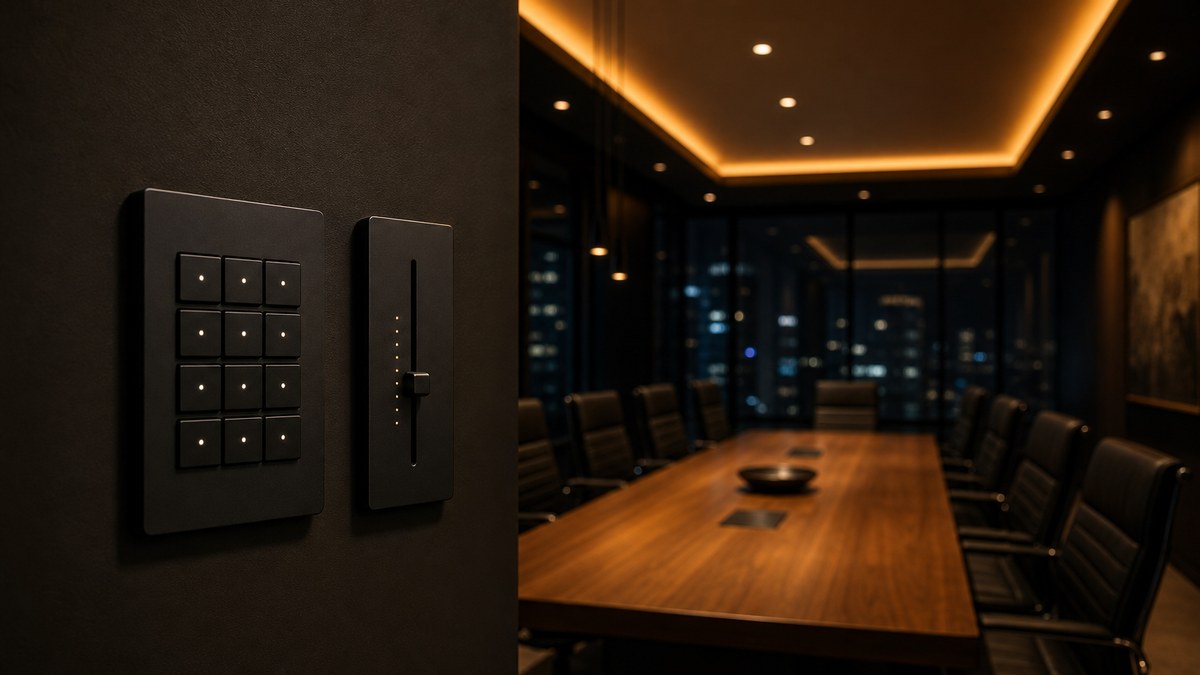
Wired, wireless and networked control systems
Controls can be delivered several ways, and the right choice depends on the building, the scope of work and how much information the owner wants from the system.
| System type | How it works | Best fit |
|---|---|---|
| Standalone room controls | Wall sensors, switches and dimmers control each room independently | Small offices, tenant suites and simple retrofits |
| Lighting control panel | Central relay panel handles schedules and building-wide switching | Retail, schools, older buildings with central circuits |
| Wired networked controls | Fixtures, sensors and keypads connected by low-voltage control wiring to a network | New construction and major renovations |
| Wireless networked controls | Fixture-mounted or nearby nodes communicate wirelessly, with a gateway and software | Retrofits, warehouses, occupied buildings, hard-to-wire ceilings |
| Luminaire-level lighting control (LLLC) | Each fixture has its own sensor and controller, grouped in software | Open offices, warehouses, flexible spaces |
| Power over Ethernet (PoE) | Fixtures are powered and controlled over network cabling | Smart-building offices and IT-centric projects |
Networked lighting controls (NLC) connect fixtures, sensors and switches into one system that can be programmed and changed in software. Zones can be regrouped when a tenant moves walls, schedules can be updated from a laptop, and many systems report energy use and occupancy patterns. The DesignLights Consortium (DLC) maintains a qualified products list for networked lighting control systems, and utility programs often reference DLC listings when they evaluate lighting projects. For a deeper look at network-powered lighting, see our PoE lighting systems guide. Codes and licensing still apply to PoE and low-voltage systems; they do not remove the need for qualified installers.
Integration is another consideration. Many owners want lighting to share information with the building automation system, security or access control, audiovisual systems or demand-response programs. Those connections should be planned at design, with clear responsibility for who programs and maintains each interface.
Lighting controls by building type
Offices
Private offices and conference rooms typically get vacancy sensors and dimming, open offices get zoned occupancy control with daylight dimming at the perimeter, and lobbies and corridors run on schedules with reduced output after hours. Scene control in conference rooms handles presentations and video calls. Tenant improvement projects in Downtown, Clearfork and the Cultural District are a common place to upgrade controls, because ceilings are already open.
Warehouses and distribution centers
High-bay LED fixtures with integrated sensors are a natural fit for Alliance, I-35W and I-20 logistics buildings. Aisles can drop to a low level when empty and brighten when a forklift or picker enters, while skylit areas dim with daylight. Our warehouse LED lighting guide covers aisle controls and light levels in detail.
Retail and restaurants
Display and accent lighting must be controlled separately from general lighting, and many owners want preset scenes for open, close, cleaning and events. Restaurants often add dimming in dining rooms and bars and scheduling for patios and signage. See our restaurant lighting guide for room-by-room ideas.
Hotels
Guestroom master controls, corridor and stair sensors, ballroom scene control and facade scheduling are core parts of hotel lighting. The Oncor commercial program has also added a lodging occupancy controls measure for hotels, motels and dormitories, subject to program rules. Read our hotel lighting guide for more.
Churches, schools and venues
Sanctuaries, auditoriums and gyms need house-light dimming, scenes and integration with stage or AV systems, while classrooms, offices and fellowship halls follow standard code controls. Our church lighting guide explains how worship and stage lighting are treated differently from general lighting.
Parking structures and exterior areas
Garages and parking lots benefit from sensors that drop light levels when areas are empty, daylight control at open perimeters and astronomical time clocks. Facades and signs follow dusk-to-dawn or business-hour schedules with late-night reduction. See our parking garage LED lighting guide and Fort Worth outdoor LED lighting guide.
Get controls that work the first time
Tell us about your building, your plans and your goals. We will review your lighting and controls and prepare a project-specific proposal.
Exterior lighting controls and dark-sky friendly design
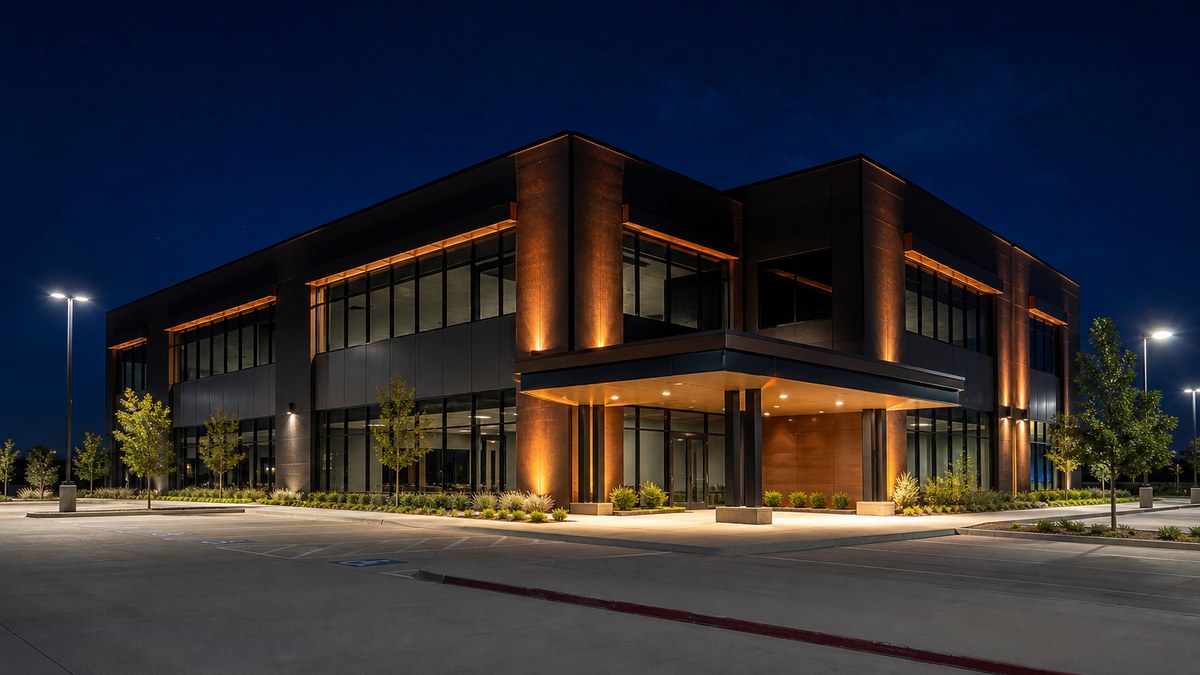
Exterior lighting is often the easiest place to find wasted energy. Parking lots lit at full output all night, facade lights left on at noon because a photocell failed, and signs glowing at 4 a.m. for empty streets are common sights. The 2015 IECC requires exterior lighting to turn off automatically when daylight is sufficient and to be reduced or turned off during late-night hours, with facade and landscape lighting shut off outside business hours, subject to exceptions for safety and 24-hour operations.
Modern exterior controls combine astronomical time clocks, which know sunrise and sunset for Fort Worth's latitude throughout the year, with photocells, motion sensors on pole fixtures and dimming. Pair those controls with full-cutoff, shielded fixtures and moderate color temperatures, and you reduce glare and light trespass onto neighbors while keeping properties safe. Facade and architectural lighting can run color or intensity scenes for holidays and events, then dim late at night. Our architectural LED lighting guide and LED signs guide cover those systems.

Retrofits vs new construction
New construction and major renovations are the simplest place to install controls, because ceilings and walls are open and the code requirements are clearly triggered. Retrofits in occupied buildings take more planning:
- Code triggers. Replacing fixtures or altering lighting systems can trigger code requirements for controls in the affected spaces. The extent depends on the scope of work and the 2015 IECC alteration provisions as amended locally; confirm with the city before you finalize scope.
- Existing wiring. Older buildings may have large circuits that serve multiple rooms, no neutral at switch boxes or no room for control wiring. Wireless and fixture-integrated controls often solve those problems with less demolition.
- Driver compatibility. Existing LED fixtures may lack dimming drivers or may not work with a new control protocol. A survey should record fixture models and drivers before controls are selected.
- Occupied spaces. Phased installation, after-hours work and clear communication keep tenants comfortable while upgrades happen.
- Historic buildings. Wireless controls can reduce cutting into plaster, masonry and historic finishes. See our historic building lighting guide.
Many owners combine an LED fixture upgrade with a controls upgrade so both are designed together. Our LED light installation guide walks through a typical project from the first site walk to switch-on.
Incentives, energy savings and how to think about value
Energy savings from controls depend on the building's hours, occupancy patterns, daylight, existing controls and how well the new system is set up. A warehouse with aisles that sit empty most of the shift, an office that empties at 6 p.m. and a parking structure that is lightly used overnight will each see different results. That is why we do not quote generic savings numbers; we look at how your building actually operates.
Commercial projects in the Oncor service area may qualify for energy-efficiency incentive programs, depending on the project and program availability. Oncor's commercial program works through approved service providers, requires DLC or ENERGY STAR listed LED products and documents existing and installed controls such as occupancy sensors with pre- and post-installation inspections. Rules change from year to year, so confirm eligibility before equipment is ordered or work begins.
Beyond energy, owners value controls for lower maintenance, longer fixture life, better tenant satisfaction, data for space planning and simpler compliance on future renovations.
Commissioning and functional testing
Controls only save energy if they are set up correctly. The 2015 IECC requires functional testing of lighting controls to confirm that hardware and software are calibrated, programmed and working properly. In practice that means checking that:
- Occupancy and vacancy sensors cover the space and turn lights off within the required time
- Time schedules, holidays and overrides are programmed correctly
- Daylight sensors are calibrated with the space finished and furnished
- Dimming ranges are smooth and fixtures turn fully off when commanded
- Exterior controls switch at dusk and dawn and reduce output overnight
- Emergency lighting behaves correctly when normal power or controls fail
At handover, the owner should receive as-built control drawings, sequences of operation, programming backups and training for the facility team. Without that documentation, the next tenant change often ends with sensors disabled and lights back on 24 hours a day.
Common lighting control mistakes to avoid
- Sensors in the wrong place. A sensor that cannot see a seated worker will turn lights off during meetings and get taped over.
- Time delays set too short or too long. Short delays annoy occupants; long ones waste energy.
- Mismatched dimming components. Drivers, dimmers and protocols must be compatible.
- No daylight calibration. Factory settings rarely suit a real space.
- Overly complex keypads. If people cannot understand the buttons, they will not use them.
- No owner training or documentation. Systems drift out of tune when nobody knows how they work.
- Ignoring emergency and egress lighting. Controls must not leave paths of egress dark when they should be lit.
How a lighting controls project works with Fort Worth LED Lights
- Site walk and review. We review your building, existing fixtures, drivers, circuits and controls, how spaces are used and what you want to achieve.
- Code and strategy. We map out which spaces need which controls under the adopted code and which extra strategies make sense for your operation.
- System selection. We recommend wired, wireless, networked or fixture-integrated controls that fit your building and budget.
- Proposal. You receive a project-specific proposal covering fixtures, controls, programming and installation.
- Installation. Licensed installers complete the work, phased around your operation where needed.
- Programming and testing. Sensors, schedules, daylight zones and scenes are programmed, calibrated and tested.
- Handover and support. Documentation, training and ongoing repair and service keep the system working.
Fort Worth LED Lights brings 15+ years as an authorized architectural lighting dealer and project coordinator. Our licensed installation partner has completed over 200 major sports and commercial projects across the US and Canada — NFL, NBA, NHL, MLS, NCAA and NASCAR. We serve owners across Fort Worth and Tarrant County; see our service areas, our full list of lighting services and our commercial lighting services. For design-build projects, learn about our Luminance program, and for lobbies that need displays, see our LED video walls guide. You can browse every guide on our blog.
Frequently Asked Questions
What lighting controls are required for commercial buildings in Fort Worth?
How quickly must occupancy sensors turn lights off?
What is the difference between an occupancy sensor and a vacancy sensor?
What is daylight harvesting?
Do I have to add controls when I retrofit to LED?
Are wireless lighting controls reliable?
What are networked lighting controls?
Can lighting controls qualify for Oncor incentives?
How much do commercial lighting controls cost?
What areas do you serve?
Smarter lighting for your Fort Worth building
Request a site walk and we will review your lighting, controls and code requirements.
Related
Our DFW lighting network: Dallas commercial LED lighting, Arlington LED lighting, Irving LED lighting, Plano LED lighting, statewide Texas LED lighting, wholesale LED components, fiber optic starlight ceilings, 360° fiber optic lighting, American LED signage, modular building solutions, and Dallas modular structures.