Parking Garage LED Lighting in Fort Worth: The Guide for Decks, Ramps, Entrances & Stairwells
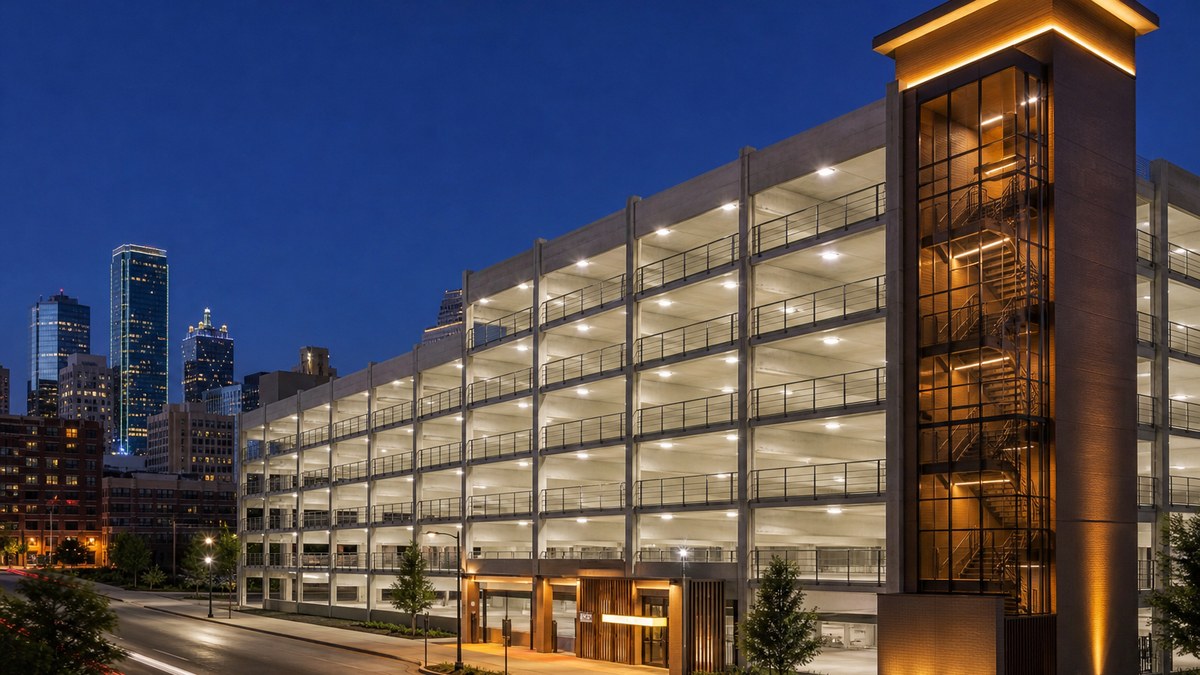
Parking garage LED lighting in Fort Worth is one of the hardest-working lighting systems in any commercial property. A garage is often the first and last part of a building that tenants, patients, hotel guests, students and shoppers experience. It runs long hours, in many cases around the clock, and it has to make a concrete structure full of columns, ramps, low ceilings and blind corners feel safe, easy to navigate and well cared for.
Many garages across Downtown, the Medical District, Near Southside, West 7th, Clearfork, the Cultural District and the Alliance corridor still run on aging high-pressure sodium or metal halide fixtures, or on early-generation LED products that were installed without a proper layout or controls. The result is the familiar picture: orange or uneven light, dark stalls between columns, glare at the ramps, dead fixtures in stairwells, and lights burning at full output on empty levels at three in the morning.
This guide explains how to plan parking garage lighting the right way: what each zone of a structure needs, which recommended practices and energy-code rules apply in Fort Worth, how controls and daylight sensors work in a garage, which fixture features survive North Texas heat and humidity, and how to retrofit a working garage without closing it. If you own, manage or are designing a parking structure, this is the checklist to work through before you request proposals.
A well-designed LED parking garage lighting system in Fort Worth includes:
- Covered parking levels: wide-distribution LED garage fixtures laid out between columns for uniform horizontal and vertical light
- Entrances and exits: higher daytime levels so drivers' eyes can adapt, reduced automatically at night
- Ramps, stairwells and elevator lobbies: continuous, glare-free light with emergency backup
- Top deck: full-cutoff pole or wall fixtures that light the deck without spilling into neighbors
- Controls: occupancy sensors, perimeter daylight dimming and time-based control, as energy codes require
- Durability: fixtures and drivers rated for heat, moisture, vibration and surges
- Pricing: a project-specific proposal after a site review
Why parking garage lighting matters more than most owners think
Garage lighting carries more responsibility than almost any other lighting in a building:
- Safety: drivers have to see pedestrians stepping out from between parked cars, curbs, wheel stops, columns and ramp transitions.
- Security: people judge a garage by how bright and even it feels. Dark corners and failed fixtures make visitors uneasy and give security cameras poor footage.
- Wayfinding: clear light on signs, level markers, stairs and elevators helps people find their car and the exit.
- First impressions: for an office tower, hotel, hospital or mixed-use project, the garage is part of the arrival experience.
- Operating cost: garage fixtures often run every hour of the year, so efficiency and controls have an outsized effect on energy and maintenance budgets.
Unlike a parking lot, which the sun lights all day, most of a covered garage depends on electric light around the clock. That is why parking structures were among the first places property owners moved to LED, and why so many early LED retrofits now deserve a second look.
The zones of a parking structure
A garage is not one space. Each zone has a different job, and a good design treats them separately:
| Zone | What it needs | Typical approach |
|---|---|---|
| Covered parking levels | Uniform horizontal light on the drive aisle and stalls, plus vertical light on faces and vehicles | Wide-distribution LED garage fixtures between column lines, occupancy dimming |
| Entrances and exits | Much higher daytime levels to ease the shift from sunlight to shade | Separately controlled transition fixtures, dimmed from sunset to sunrise |
| Ramps | Even light across slope changes with no glare toward drivers | Fixtures aimed with the slope, careful mounting near ramp transitions |
| Perimeter bays | Daylight from open sides much of the day | Photosensor-controlled rows that dim when daylight is enough |
| Stairwells and elevator lobbies | Bright, welcoming, always-on safety lighting | Vandal-resistant fixtures with emergency battery or generator backup |
| Top deck | Open-air light like a parking lot, without light trespass | Full-cutoff pole heads or parapet-mounted fixtures |
| Pay stations, gates and booths | Higher task light for transactions and cameras | Local fixtures with good color rendering |
How bright should a parking garage be? Recommended light levels
Garage light levels are guided by the Illuminating Engineering Society's recommended practice for parking facilities (IES RP-20) and by security guidance. These are design targets, not code minimums, and the right numbers for your property depend on its use, hours and risk profile. A few published reference points are useful when you compare proposals:
- The U.S. Department of Energy's Commercial Building Energy Alliance (CBEA) high-efficiency parking structure specification, based on IES RP-20, calls for a minimum of 2.0 footcandles horizontal and 1.2 footcandles vertical in basic covered parking, with a maximum-to-minimum uniformity of 7:1.
- The same specification sets vehicle entrances and exits at 60 footcandles minimum in daytime and 1.0 at night, because drivers coming in from bright Texas sun need time for their eyes to adjust.
- For ramps it lists 2.0 footcandles horizontal day and night, and for an uncovered top deck 0.75 footcandles minimum with 10:1 uniformity.
- Security guidance cited by ASIS Security Management lists 5 footcandles with a 4:1 uniformity ratio for parking structures where security is a priority.
Two things matter as much as the footcandle number. The first is uniformity: a garage with bright pools under each fixture and dark gaps between them feels less safe than one with lower but even light. The second is vertical illuminance: light on people's faces and on the sides of vehicles is what lets drivers spot pedestrians and lets cameras identify people. A proper photometric layout shows both, measured at the level the recommended practice describes, so you can compare proposals on the same basis.
Tip: ask every bidder for a photometric layout of a typical level, the entrance and the top deck, showing minimum, average and maximum-to-minimum uniformity. Comparing fixture counts alone tells you very little.
Covered parking levels: layout, optics and mounting
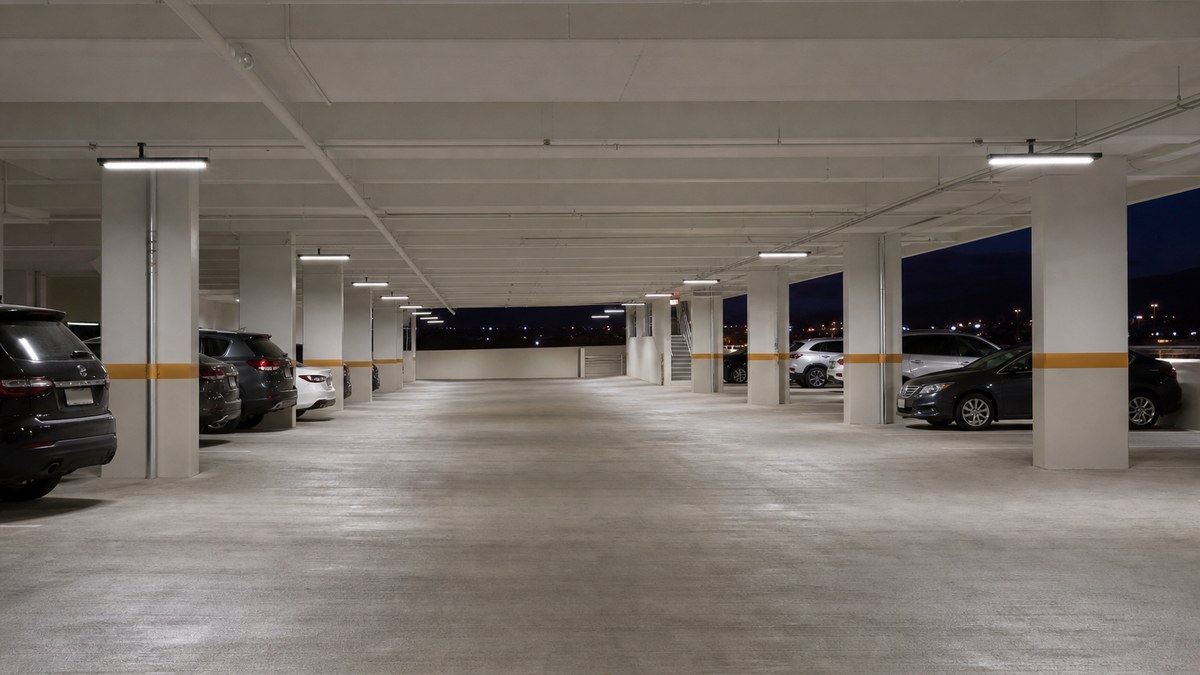
The covered levels are the bulk of every garage, and they are where good and poor designs differ most. Ceiling heights are low, beams and columns cast shadows, and parked vehicles block light. LED garage fixtures are built for exactly these conditions:
- Wide, low-angle distribution pushes light sideways across stalls and onto vertical surfaces rather than straight down into a bright spot on the floor.
- Placement relative to the structure matters. Fixtures are usually set along drive aisles and between column lines so beams and double tees do not cut the light pattern.
- Up-light component: a small amount of light on the ceiling brightens the space and reduces the cave effect, especially with painted ceilings.
- Glare control: drivers look toward fixtures constantly, so lenses and optics should limit harsh brightness at eye level.
- Mounting: surface, pendant or beam-clamp mounts must suit the structure. Post-tensioned slabs need special care before anyone drills into them, so attachment methods should be confirmed with the structure's engineer or owner's records.
White, painted ceilings and walls make a significant difference to how bright a garage feels, so lighting upgrades are often timed with repainting or restriping. Painting is outside our scope, but we design with your surface finishes in mind.
Entrances, exits and daylight transition zones
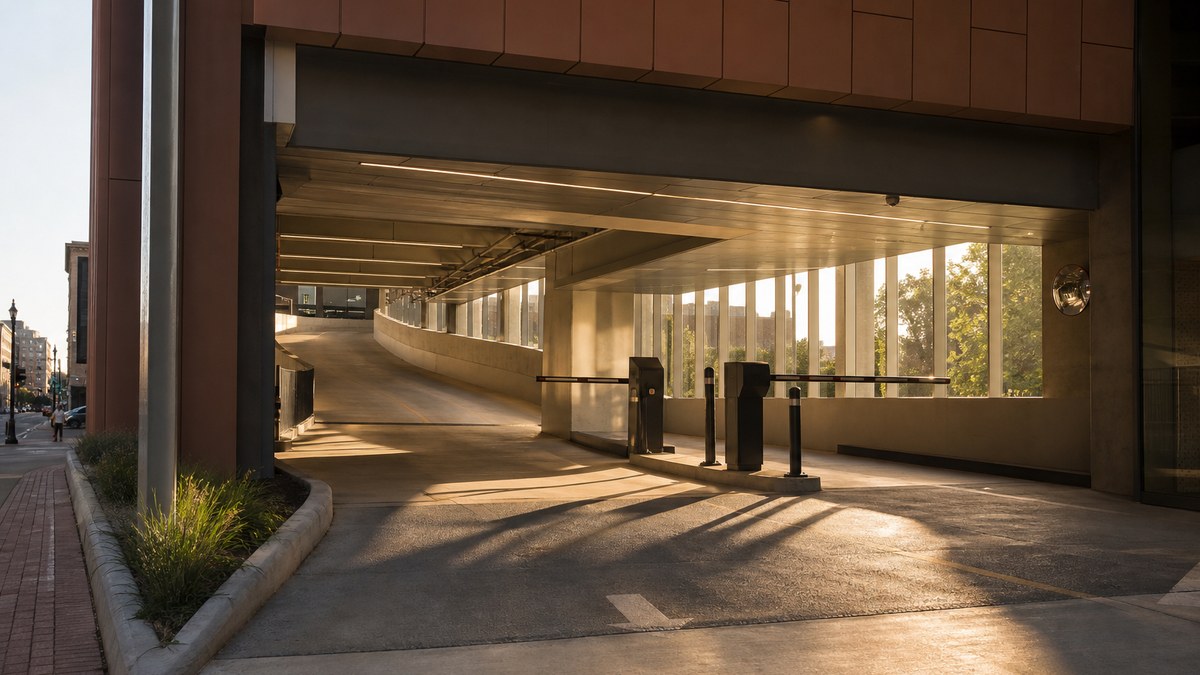
At noon in August, a Fort Worth driver pulling off a sunlit street into a garage entrance is effectively driving into a cave. Eyes take time to adapt, and that is when pedestrians, gate arms and ticket machines are hardest to see. That is why recommended practice calls for much higher daytime light at entrances and exits than at night.
A well-designed entrance has a dedicated group of fixtures controlled separately from the rest of the level. A photosensor or astronomical time clock raises output during the day and reduces it at night, when the contrast problem reverses. This also lines up with energy-code requirements for separately controlled transition zones, covered below.
Ramps, stairwells and elevator lobbies
Ramps combine changing slope, curves and merging traffic. Fixtures should be located so drivers coming up a ramp are not staring into them at the crest, and so light is continuous through the transition from one level to the next.
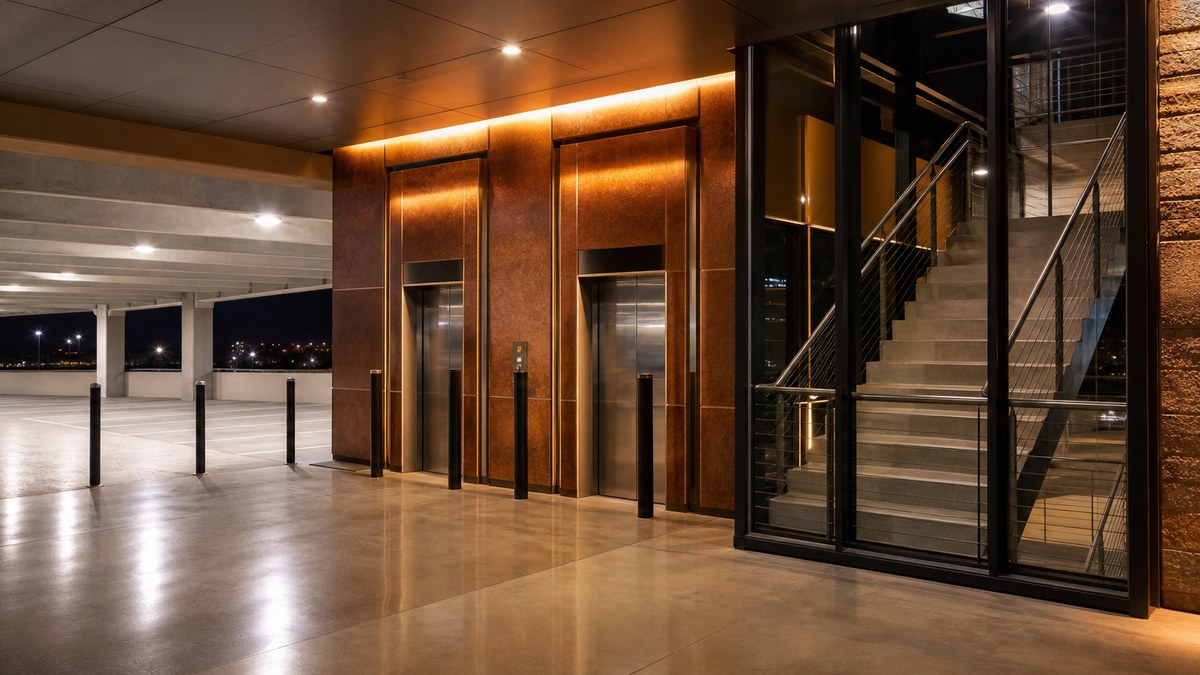
Stairwells and elevator lobbies are where people walk alone, so they deserve bright, even, welcoming light and robust, vandal-resistant fixtures. They are also part of the means of egress, which ties them to life-safety requirements for emergency lighting. Security guidance summarized by ASIS notes the NFPA baseline: emergency lighting must come on within 10 seconds of a power loss and last at least 90 minutes, with an average of at least 1 footcandle along exit routes at the start. Your engineer and the authority having jurisdiction confirm exact requirements for each project.
Energy code requirements for Fort Worth parking garages
Fort Worth's Building & Energy Codes page lists the 2015 International Energy Conservation Code (IECC) with local amendments, with ASHRAE Standard 90.1 available as an alternative compliance path. The 2026 National Electrical Code took effect in Fort Worth on September 1, 2026, and electrical work is performed by electricians licensed through the Texas Department of Licensing and Regulation (TDLR).
Parking garages have had specific lighting-control rules in ASHRAE 90.1 since the 2010 edition, and newer IECC editions added similar provisions. As summarized by National Grid's guide to ASHRAE 90.1-2010 Section 9.4.1.3, the core requirements are:
- Automatic reduction: lighting power in a zone drops by at least 30% when no activity is detected for 20 minutes.
- Automatic shutoff through schedules or occupancy control.
- Zone size: occupancy and perimeter daylight zones no larger than 3,600 square feet.
- Perimeter daylight dimming: fixtures near open perimeter walls with daylight potential are separately controlled and dim automatically when daylight is available.
- Transition zones: covered vehicle entrances and exits are controlled separately and reduced by at least 50% from sunset to sunrise.
Which edition and which path applies depends on your project, its permit date and the compliance path your design team uses. On new construction, additions and substantial alterations, we coordinate the control design with your engineer of record and the City of Fort Worth's requirements so the system is designed to comply from day one.
Make your garage brighter, safer and smarter
Tell us about your structure, levels and hours. We will walk the garage and prepare a project-specific proposal.
Controls: where garages save the most energy
Because garages run so many hours, controls are where an LED upgrade really pays off. The U.S. Department of Energy's GATEWAY demonstration at the Department of Labor headquarters garage in Washington, D.C. is one of the best-documented examples. It replaced high-pressure sodium fixtures with LED garage fixtures that had built-in occupancy sensors and multi-level drivers. The report found that most of the savings came from the LED conversion itself, and that controls added more on top. It also offered practical lessons that still apply today:
- Sensor delay matters. When the delay was shortened from the factory 10 minutes to 2.5 minutes, the share of time fixtures spent at high output fell from about 47% to about 17%, and users did not complain.
- Placement matters. Sensors near busy entrances save little because they are triggered almost constantly. Airflow from nearby air handlers appeared to cause some false triggers.
- Commissioning matters. Settings had to be adjusted after installation, so programming and verification should be part of every scope.
- Uniformity improved. Average light fell but the minimum rose, so the LED system was more even than the old sodium lighting.
Modern garage controls come in several forms:
| Control | What it does in a garage |
|---|---|
| Fixture-integrated occupancy sensors | Each fixture dims to a low level when its area is empty and returns to full output when a car or person approaches |
| Zoned or networked sensors | Groups of fixtures brighten together so a driver sees light ahead, not just overhead |
| Perimeter photosensors | Dim or switch rows near open sides when daylight is enough |
| Astronomical time clock | Sets day and night modes for entrances, the top deck and transition zones |
| Networked lighting controls | Remote scheduling, outage alerts and energy reporting for portfolios and campuses |
The low or dimmed level should never leave a garage dark. A common design approach is to dim unoccupied areas rather than switch them off, so the garage always reads as lit and safe while still cutting energy use. Settings are tuned during commissioning to match how your garage is actually used.
Color temperature and color rendering
Most commercial garages use neutral to cool white light, typically around 4000K, because it reads as clean and bright and helps cameras and people pick out details. Warmer light around 3000K can suit hotel and residential garages or a top deck next to homes, where a softer look and less sky glow matter. Whatever you choose, keep it consistent across the structure: a garage that mixes new white LEDs with old orange sodium fixtures looks neglected even when every light works.
Good color rendering helps people find their car by color, helps security staff describe vehicles and clothing, and makes the space feel more comfortable. It is worth asking for color rendering information on every fixture proposed.
Built for North Texas conditions
Open-sided parking structures are semi-outdoor spaces. Fixtures there see summer heat, humidity, wind-driven rain, dust from traffic and vibration from vehicles. In Fort Worth, they also face lightning-related surges during spring storms. Specify for those conditions:
| Condition | What to specify |
|---|---|
| Heat in upper levels and top decks | Drivers and fixtures rated for high ambient temperatures |
| Rain and washdown | Wet-location ratings, sealed housings and gasketed connections |
| Dust and exhaust film | Smooth, easy-to-clean lenses and housings that shed dirt |
| Vibration from traffic | Secure mounts and hardware suited to the structure |
| Surges | Surge protection in fixtures and on circuits |
| Impact and vandalism | Durable, impact-resistant lenses in stairwells and low-mounted locations |
Retrofitting an existing garage
Most garage projects in Fort Worth are retrofits of structures that have to stay open. A good retrofit plan keeps parking available and minimizes disruption:
- Site walk and survey. We walk every level, entrance, ramp, stairwell and the top deck, ideally both in daylight and at night, and note dark areas, failed fixtures, glare and wiring conditions.
- Existing conditions. We review circuits, panels, controls, emergency lighting and mounting conditions, including any slab or structural constraints.
- Photometric design. A layout models light levels and uniformity for typical levels, entrances, ramps and the top deck.
- Control strategy. Occupancy zones, perimeter daylight rows, transition zones and schedules are planned to meet the applicable code path.
- Proposal. A clear scope and project-specific price, including phasing.
- Phased installation. Work moves level by level or bay by bay, often at night or on weekends, with sections coned off so the rest of the garage stays open.
- Commissioning. Sensors, delays, dim levels and daylight settings are programmed and verified, and light levels are checked.
- Close-out and service. Documentation, spare parts guidance and maintenance planning.
Our LED light installation guide walks through this process in more detail for all commercial projects, and our repair and service team can keep the system running afterward.
New parking structures and mixed-use projects
On new construction, lighting should be part of the conversation early, while the structural grid, ceiling finishes, electrical rooms and conduit routes are still on paper. Coordinating fixture locations with beams, sprinklers, signage, cameras and EV charging stations avoids conflicts in the field. For mixed-use developments, the garage lighting can match the design language of the lobby and facade, and top-deck lighting can be designed with neighbors in mind. Our Luminance design-build program takes lighting from concept to commissioning for owners who want one team responsible for the whole result.
Top decks and being a good neighbor
The top level of a garage is really a rooftop parking lot. It needs pole-mounted or parapet-mounted fixtures with full-cutoff optics, controlled by photocell or time clock, and often dimmed late at night. Because top decks are elevated, light can easily spill into nearby homes, apartments and hotel rooms. Shielding, careful aiming and appropriate color temperature keep the light on the deck. Our Fort Worth outdoor LED lighting guide covers parking lot lighting, wall packs and site lighting in more depth.
Security, cameras and signage
Lighting and cameras should be designed together. Uniform light with good vertical illuminance gives cameras usable images; glare sources pointed at lenses or deep shadows behind columns defeat them. When planning an upgrade, walk the garage with your security provider so camera views, emergency call stations and pay areas are well lit.
Wayfinding signage, level markers, height bars and illuminated exit signs work best when they are lit consistently. For illuminated garage signage, monument signs at the entrance or LED message displays, see our LED sign guide and our partners at American LED Signage.
Garages by property type
Office towers and corporate campuses
Tenants park daily and form an impression of the building before they reach the lobby. Bright, even light, clear wayfinding and a welcoming elevator lobby support leasing and retention. Pair the garage with interior upgrades from our commercial LED lighting services, and consider PoE and networked lighting where the building is going smart.
Hospitals and medical offices
Medical District garages run around the clock and serve patients, visitors and shift staff who may be stressed, tired or unfamiliar with the campus. Consistent light, clear wayfinding and well-lit drop-off areas matter here more than anywhere.
Hotels and venues
Hotel and event garages see heavy surges in traffic. Lighting should make guests feel looked after from the moment they drive in. Our hotel lighting guide covers the rest of the property.
Retail, restaurants and mixed-use
Shoppers and diners in districts like West 7th, Sundance Square and Clearfork judge a destination by how easy and safe it is to park. See our restaurant lighting guide for patios and dining rooms.
Universities, apartments and logistics campuses
Student and resident garages need dependable light at all hours, while employee garages at distribution centers serve shift changes. For the buildings themselves, see our warehouse LED lighting guide.
Common parking garage lighting mistakes
- One-for-one swaps with no layout. Replacing each old fixture with an LED of similar wattage ignores how differently LED optics distribute light. A layout often improves uniformity and can change fixture counts.
- Chasing brightness instead of uniformity. Bright spots and dark gaps feel worse than even, moderate light.
- Ignoring vertical light. Floors may measure well while faces and car sides stay dark.
- Default sensor settings. Factory delays and dim levels rarely match real traffic. Commission them.
- Forgetting the entrances. A dim daytime entrance is one of the most common garage complaints.
- Overlooking emergency lighting. Stairwells and egress paths need working backup, tested on schedule.
- Skipping surge protection. North Texas storms can take out drivers across a level.
- Mixed color temperatures. Partial upgrades leave a patchy, neglected look.
Maintenance and long-term performance
LED dramatically reduces lamp changes, but garages still need care. Lenses collect exhaust film and dust, sensors can be knocked out of alignment, and storms can damage drivers. A simple maintenance plan includes periodic night walks, lens cleaning in dirty areas, testing emergency lighting, checking sensor and daylight settings after any layout changes, and fast repair of outages so dark spots do not linger. If your garage already has LED fixtures that are flickering, failing or poorly controlled, our commercial lighting team can evaluate whether repair, control upgrades or replacement makes most sense.
Energy savings and utility incentives
Moving a garage from high-pressure sodium or metal halide to LED with occupancy and daylight controls commonly reduces energy use substantially, and long LED life cuts the maintenance visits that are expensive in a structure that has to stay open. Commercial lighting projects in the Oncor service area may qualify for energy-efficiency incentive programs, depending on the project and program availability at the time; programs typically call for qualifying products such as DLC-listed fixtures and are offered through participating service providers. We help you understand what may apply to your project as part of the proposal.
Why choose Fort Worth LED Lights
We handle parking garage lighting from the first site walk through design, controls, installation, commissioning and service. Our team brings 15+ years as an authorized architectural lighting dealer and project coordinator. Our licensed installation partner has completed over 200 major sports and commercial projects across the US and Canada — NFL, NBA, NHL, MLS, NCAA and NASCAR. We serve Fort Worth and Tarrant County, including the areas listed on our homepage, and you can see everything we do on our services overview and commercial lighting services page. For the building above the garage, our architectural lighting guide and LED video wall guide cover facades and lobbies, and the Fort Worth LED Lights blog has guides for every property type.
Frequently Asked Questions
How bright should a parking garage be?
Why do parking garage entrances need more light during the day?
Do parking garages need occupancy sensors?
Which energy code applies to garages in Fort Worth?
What color temperature is best for a parking garage?
Can a garage stay open during an LED retrofit?
How much does parking garage LED lighting cost in Fort Worth?
Do parking garage lighting upgrades qualify for incentives?
What about emergency lighting in garage stairwells?
What areas do you serve?
Let's light up your parking structure
Request a consultation and we will follow up to schedule a garage walk-through.
Related
Our DFW lighting network: Dallas commercial LED lighting, Arlington LED lighting, Irving LED lighting, Plano LED lighting, statewide Texas LED lighting, wholesale LED components, fiber optic starlight ceilings, 360° fiber optic lighting, premium pool lighting, modular building solutions, and Dallas modular structures.