Hotel Lighting in Fort Worth: The LED Guide for Lobbies, Guestrooms, Ballrooms & Facades
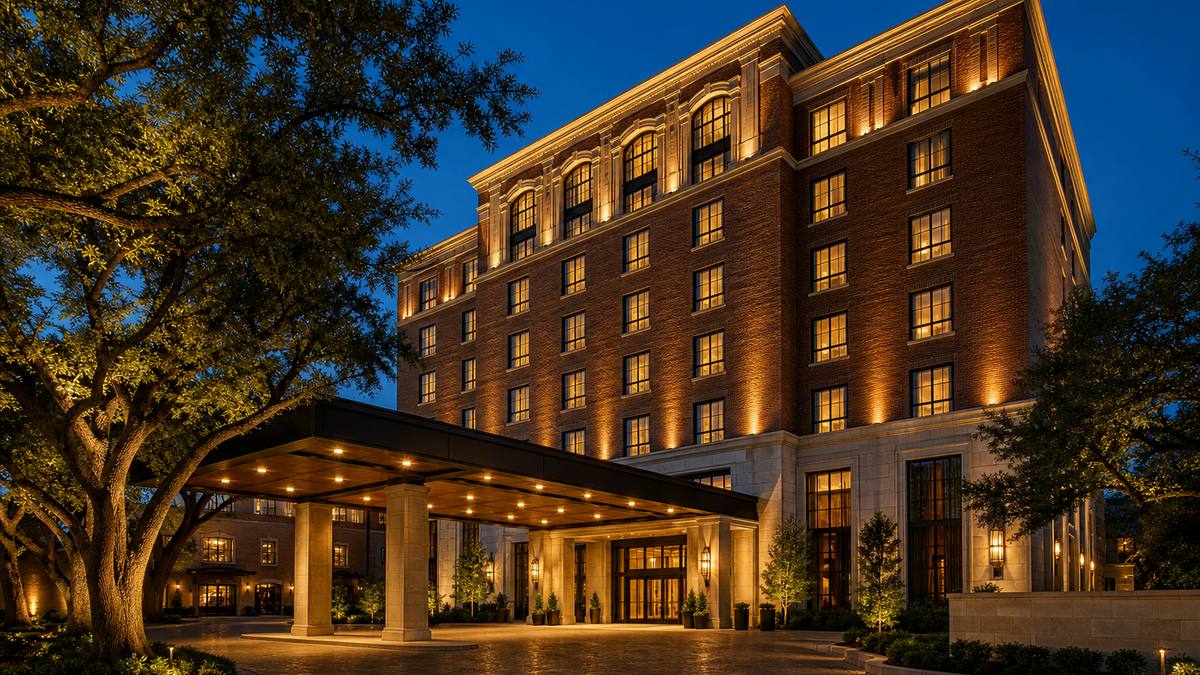
Hotel lighting in Fort Worth is one of the few building systems a guest notices in the first five seconds. It is the glow of the facade from the highway, the warmth of the porte-cochère at check-in, the calm of the lobby at midnight, the switch by the bed that does exactly what the guest expects, and the ballroom that can change from a business keynote to a wedding reception in an afternoon. Done well, lighting quietly supports the brand, the guest reviews and the operating budget at the same time.
Fort Worth's hospitality market gives owners plenty of reasons to get it right. Downtown and Sundance Square host conventions and weekend visitors, the Stockyards draws tourists all year, the Cultural District and Dickies Arena bring event crowds, and the Near Southside, West 7th and Clearfork areas keep adding boutique and select-service properties. Major expansions and historic renovations are moving forward across the city, and every one of them faces the same questions about LED fixtures, controls, energy code and guest comfort.
This guide walks through hotel lighting area by area: exteriors and facades, arrival and lobby, guestrooms and suites, corridors, ballrooms and meeting space, restaurants and bars, pools and amenity decks, and back-of-house. It also covers color temperature, controls, the energy code Fort Worth has adopted, how to plan a renovation without closing floors for long, and what to ask a lighting partner before you commit.
Good hotel LED lighting in Fort Worth comes down to a handful of decisions:
- Layers, not just fixtures: ambient, task and accent light in every guest-facing space
- Warm, high-quality light: warm white (often 2700K–3000K) with high color rendering in guest areas
- Dimming everywhere guests linger: lobby, restaurant, bar, ballroom and guestroom scenes
- Simple guestroom controls: intuitive switching plus the automatic shutoff the energy code requires
- Exterior identity: facade, porte-cochère, signage and parking lit as one design
- Built for operations: long-life, serviceable fixtures, consistent spares and phased installation
- Pricing: every property gets a project-specific proposal after a site review
Why hotel lighting matters more than most owners think
Lighting touches almost every part of a hotel's performance:
- First impressions and reviews. Guests describe how a space feels, and light is a large part of that feeling. Harsh, flat or flickering light shows up in photos and reviews.
- Brand standards. Flagged hotels work to brand lighting standards for public areas and rooms, and independent properties use lighting to create a recognizable identity.
- Revenue spaces. Ballrooms, meeting rooms, restaurants, bars and rooftops sell better when lighting can be tuned for each event and each time of day.
- Operating cost. Corridors, lobbies, garages and exterior lighting run many hours every day. Efficient LED and good controls reduce energy use and the constant cycle of lamp changes.
- Safety. Even light in parking, entrances, stairs and corridors helps guests and staff move safely at any hour.
Exterior, facade and arrival lighting
A hotel's exterior is its billboard after dark. In Fort Worth, where historic brick and limestone sit beside modern glass towers, the right approach depends on the building:
- Facade lighting: wall washing for broad surfaces, grazing to bring out masonry texture, and linear outlining for rooflines and vertical bands. Color-changing systems let a property mark holidays, local teams and city events.
- Porte-cochère and drop-off: bright enough for safe vehicle and luggage movement, warm enough to feel welcoming, and glare-controlled so guests are not squinting at the canopy.
- Signage: monument signs, building letters and blade signs that stay readable from the road.
- Parking and garages: uniform LED area and garage lighting, with motion-based dimming in low-traffic hours.
- Landscape: path lights, uplighting on trees and features, and step lights that make the walk from the car feel safe.
Our architectural LED lighting guide covers facade techniques in depth, our outdoor LED lighting guide covers parking, garages and site lighting, and our LED signs guide covers channel letters and monument signs. Historic properties need extra care: fixtures should be mounted and wired in ways that protect original masonry, and light should reveal the architecture rather than flatten it.
Lobby and public spaces
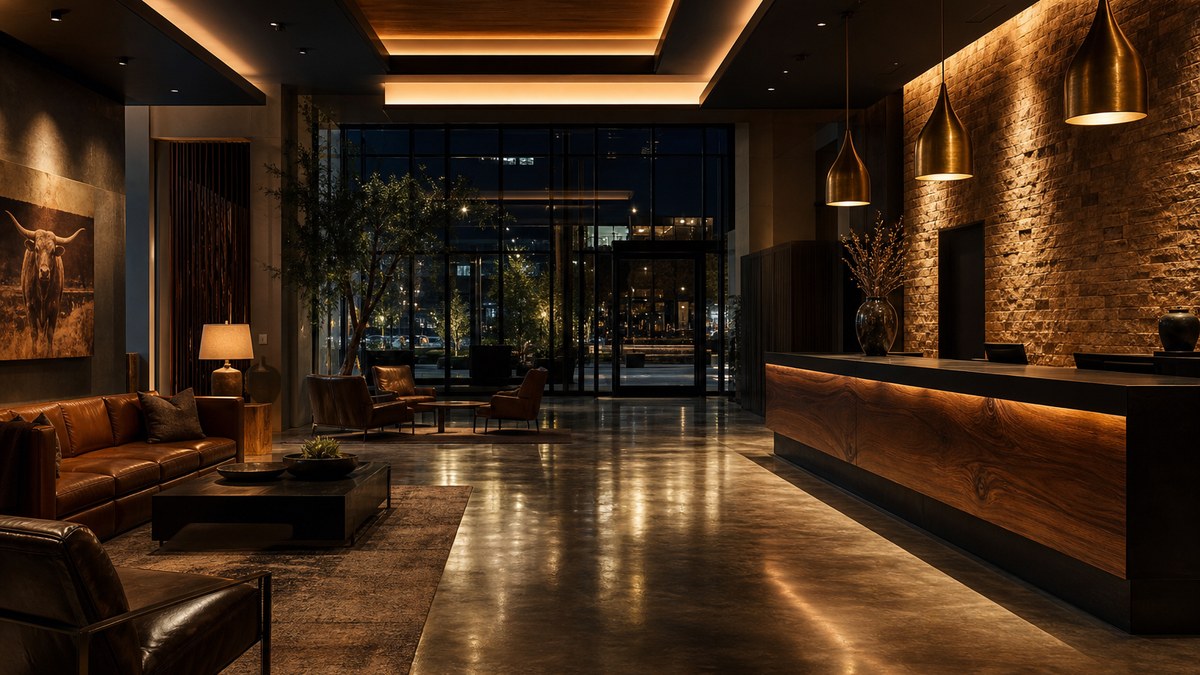
The lobby sets the tone for the whole stay. It also has to work at 3 p.m. for a busy check-in rush and at 2 a.m. for a quiet arrival. That is why lobby lighting is designed in layers:
- Ambient light from coves, downlights or decorative pendants that fills the space evenly.
- Task light at the front desk, concierge and business center, where staff and guests read screens and documents.
- Accent light on artwork, feature walls, plants and architectural details, which gives the room depth.
- Decorative light such as chandeliers and statement fixtures, often a key part of the design story.
Each layer should be on its own dimmable zone so the lobby can move through scenes during the day: brighter and crisper during daytime, warmer and lower in the evening, and softer late at night. Lobbies with large windows benefit from daylight-responsive dimming, which lowers electric light when the sun does the work. A feature like an LED video wall behind the desk or a fiber optic starlight ceiling over a lounge can become the space's signature; see our LED video walls guide for displays.
Color temperature and color quality
Two specifications matter more than almost anything else in guest-facing hotel spaces:
| Space | Typical color temperature approach | Notes |
|---|---|---|
| Lobby and lounges | Warm white, often 2700K–3000K | Dimmable scenes for day, evening and late night |
| Guestrooms and suites | Warm white, often 2700K–3000K | Dim-to-warm fixtures create a residential feel |
| Restaurants and bars | Warm white, sometimes warmer at night | Low, focused light on tables; good color for food |
| Ballrooms and meeting rooms | Warm to neutral, sometimes tunable | Brighter for presentations, warmer for receptions |
| Corridors and elevator lobbies | Match adjacent guest areas | Consistency matters more than brightness |
| Back-of-house and kitchens | Neutral white, often 3500K–4000K | Task visibility and cleaning standards |
| Parking and site | Often 3000K–4000K | Warmer near homes and historic districts |
Color rendering (CRI, or the newer TM-30 metrics) describes how naturally light shows skin tones, fabrics, wood and food. High color rendering, commonly 90 CRI or above in guest areas, makes finishes look the way the designer intended and makes people look healthy and relaxed. It is one of the clearest differences between a budget retrofit and a hospitality-grade installation.
Consistency is the other half. Mixing fixtures from different batches or brands can leave visible color shifts along a corridor or across a ceiling. Specifying tight color consistency and buying replacements from the same product family keeps spaces looking uniform for years.
Guestrooms and suites
The guestroom is where lighting most directly shapes the guest's opinion of the stay. Most complaints come from a few familiar problems: switches that are hard to find, lights that cannot be turned off from the bed, harsh vanity light, dark closets and glowing indicator LEDs at night. A good guestroom lighting plan addresses each one:
- Entry: a light that comes on as the guest enters, so nobody fumbles in the dark with luggage.
- Bedside: individual reading lights for each side of the bed and an easy “all off” within reach.
- Desk and work area: glare-free task light for laptops and paperwork.
- Bathroom and vanity: even, front-facing light on the face with good color rendering, plus a low night light so guests are not blinded at 3 a.m.
- Closet and luggage areas: enough light to find things, ideally switching automatically.
- Decorative and cove lighting: headboard backlighting or coves that give the room a residential warmth.
Simple scene control helps: a “welcome” scene, a “relax” scene, a “night” scene and a master off. Labeled keypads and consistent switch locations across every room reduce guest confusion and calls to the front desk. Suites can add dimmable living-area layers and features such as a fiber optic starlight ceiling in a signature suite or media room.
Energy code note: Fort Worth uses the 2015 IECC with local amendments (with ASHRAE 90.1 as an alternative path). The IECC includes specific requirements for hotel and motel guestrooms, including automatic controls that turn off lighting and switched receptacles after the room is vacated, typically within 20 minutes, and occupancy-based controls in spaces such as corridors and lobbies. The compliance path for each project is confirmed with the design team and the City of Fort Worth during permitting.
Corridors, elevator lobbies and stairs
Corridors are long, run all day and night, and are easy to get wrong. Common problems include dark spots between downlights, glare from bare sources, and visible color differences after years of piecemeal lamp replacements. A consistent LED solution, whether wall sconces, coves or downlights, gives even, comfortable light along the full length.
Because corridors are often empty, occupancy-based dimming can lower light levels when nobody is present and bring them up smoothly when a guest steps off the elevator, without ever leaving the space dark. Stairs and egress paths must stay lit to code, with emergency lighting that works during a power outage. Emergency drivers, central inverters and regular testing keep egress lighting ready when it is needed.
Planning a renovation or new property?
Tell us about your hotel, the spaces you want to update and your timeline. We will review the property and prepare a project-specific proposal.
Ballrooms, meeting rooms and event space
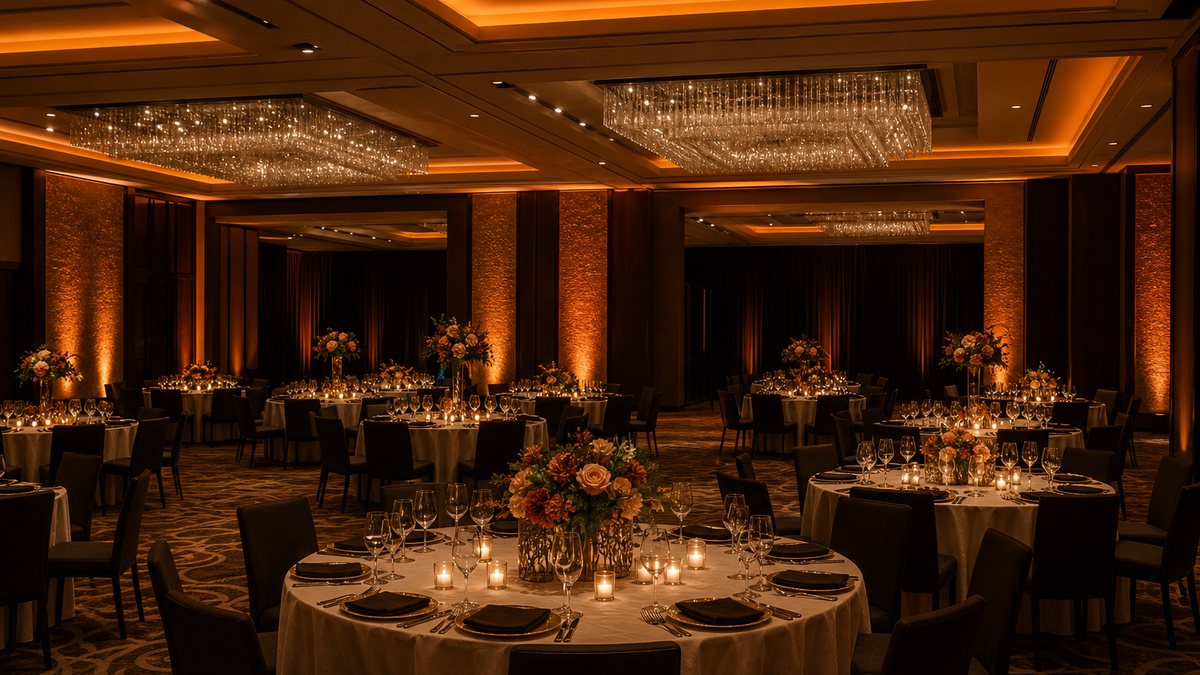
Event space earns its keep by being flexible. The same ballroom may host a breakfast meeting, a product launch, a quinceañera and a gala dinner in a single week, and each one needs a different look. Good ballroom lighting includes:
- Smooth dimming across the full range, with no flicker on camera, because nearly every event is now photographed and streamed.
- Preset scenes such as presentation, dinner, dancing and cleaning, recalled from a simple wall station or touch panel.
- Partition-aware controls that follow air walls, so each divided room has its own lighting.
- Color and accent lighting on walls, coves and ceilings, so planners can match event colors without renting as much equipment.
- Presentation support such as zones that dim near screens, or permanent LED video walls in place of projectors.
Meeting rooms benefit from the same thinking at a smaller scale: a bright, comfortable working scene, a presentation scene, and occupancy sensors that turn lights off when a session ends. Pre-function areas and foyers should match the ballroom's character, since that is where guests gather before and after.
Restaurants, bars and rooftops
Hotel restaurants and bars compete with the best independent spots on West 7th, Magnolia Avenue and in the Stockyards, and lighting is a big part of that competition. Low, focused light on tables, warm backlighting on bar shelves, glowing under-counter lines and dimmable pendants create a space where guests want to order one more round. Scenes that shift from breakfast to lunch to dinner to late night let one room serve several moods.
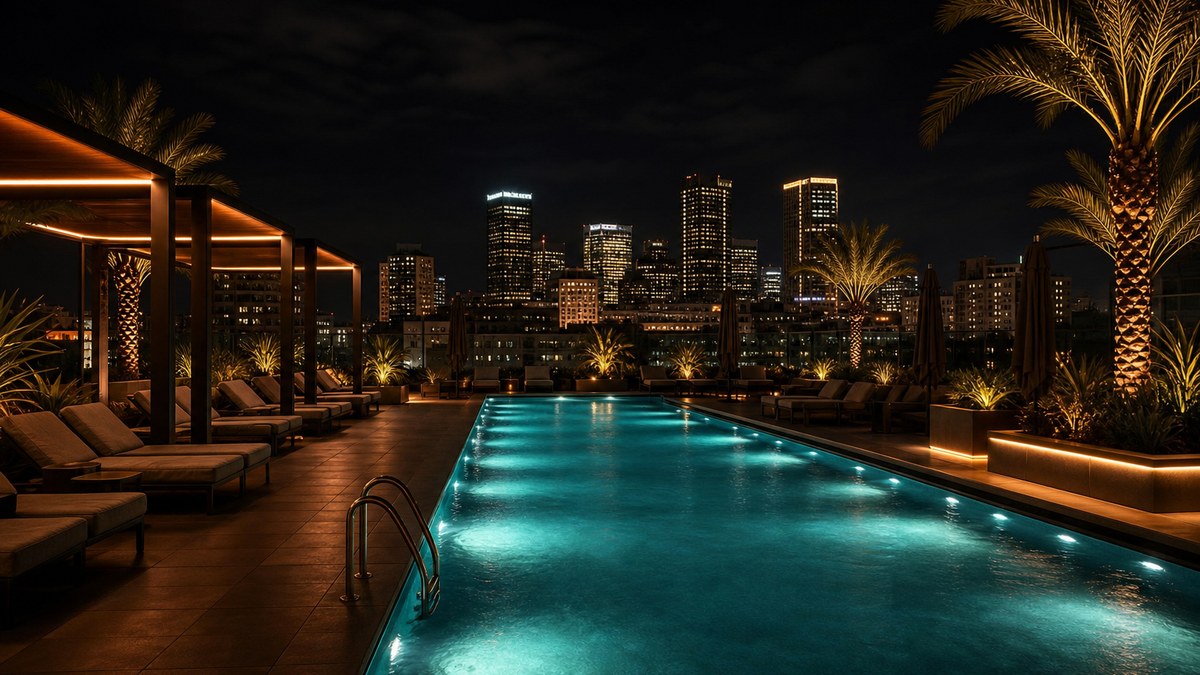
Rooftops and patios need outdoor-rated fixtures, sealed connections and drivers that can handle Texas summer heat. String and festoon lighting, linear lights under rails and planters, and warm uplighting on structures create atmosphere, while glare control keeps neighbors and passing drivers comfortable.
Pools, spas and amenity decks
Pool decks and spas are increasingly used after dark for events, cabana rentals and evening lounging. Underwater LED pool lights, lit water features, deck uplighting and safe path lighting turn the amenity deck into a night-time destination. Water and electricity call for specialized equipment and installation; our network partners at Premium Pool Lighting handle commercial pool lighting, and 360 Fiber Lighting designs fiber optic effects for water features and spas where no electricity can be near the water.
Back-of-house, kitchens and service areas
Guests never see back-of-house, but staff spend whole shifts there. Kitchens, laundry, housekeeping storage, loading docks, mechanical rooms and staff corridors need bright, even, neutral light that makes cleaning and safety checks easier. Sealed, wipe-down fixtures suit kitchens, occupancy sensors cut waste in storage and mechanical rooms, and LED dock lighting supports early-morning deliveries. Upgrading these areas is often one of the simplest ways to reduce a hotel's lighting energy use, because many back-of-house spaces still run older fluorescent fixtures for long hours.
Controls that work for guests and staff
Controls make the difference between a lighting system that saves energy and one that simply looks nice. In hotels, controls must also be easy for guests and staff to use:
- Guestroom controls: clear keypads, master off, and vacancy-based shutoff that works with the room's key-card or occupancy system.
- Public-area scenes: time-of-day schedules that shift the lobby, restaurant and corridors automatically.
- Occupancy and vacancy sensors: meeting rooms, restrooms, storage, back-of-house and garages.
- Daylight harvesting: dimming near windows and skylights in lobbies and restaurants.
- Exterior controls: photocells and astronomical time clocks, with late-night dimming where appropriate.
- Networked systems: central monitoring so engineering teams can see outages and adjust schedules without walking every floor.
Newer properties are also looking at PoE (Power over Ethernet) lighting, which carries power and data over network cabling and makes lighting part of the building's smart systems. Electrical codes and licensing still apply with PoE, so it should be planned with the electrical and IT teams from the start.
Renovating without closing the hotel
Hotels rarely have the option to close. Lighting upgrades are therefore planned around occupancy, events and brand deadlines:
- Site walk and audit. We walk the property by day and at night, inventory existing fixtures and controls, and note problem areas, outages and guest complaints.
- Design and mock-up. A lighting plan for each area, and often a mock-up guestroom or corridor section so owners and brand teams can approve the look before rollout.
- Proposal. A clear scope and project-specific price, with options for phasing.
- Phased installation. Guestroom floors are taken out of inventory in small blocks, public areas are worked overnight or in low-occupancy periods, and ballrooms are scheduled around the events calendar.
- Commissioning. Scenes programmed, sensors adjusted, emergency lighting tested and staff trained.
- Service. Spare parts strategy, periodic checks and quick repairs to keep every space looking as intended.
Our LED light installation guide explains the process from site walk to switch-on in more detail, and our Luminance design-build program covers complete lighting transformations from concept through installation.
Common hotel lighting mistakes
- One-for-one lamp swaps without a plan. Screw-in LED replacements can leave mismatched color, poor dimming and glare. A proper design often achieves a better look with fewer fixtures.
- Choosing cool, harsh light for guest areas. Bright, blue-white light can make a lobby or room feel clinical.
- Ignoring dimmer compatibility. LED drivers and dimmers must be matched, or guests see flicker, buzzing or lights that drop out at low levels.
- Over-complicated guestroom controls. If guests cannot figure out the switches in a few seconds, the system is too complex.
- Forgetting maintenance access. Fixtures in tall atriums, over stairs and above pools need a plan for service.
- Treating exterior lighting separately. Facade, porte-cochère, signs and parking should look like one consistent design.
Energy savings and Oncor incentives
Hotels run lighting around the clock, so moving from older halogen, fluorescent and metal halide sources to LED, combined with controls, commonly cuts lighting energy use substantially and greatly reduces lamp replacement labor. Long-life LED fixtures also mean fewer service calls in hard-to-reach atriums, ballrooms and exteriors. Many commercial LED projects in the Oncor service area may qualify for energy-efficiency incentive programs, depending on the project and current program availability; qualifying projects typically use DLC- or ENERGY STAR-listed products and go through a participating service provider. We help identify likely opportunities during the proposal stage.
Hotel lighting by property type
Full-service and convention hotels
Large lobbies, multiple restaurants, extensive ballroom and meeting space, and high guestroom counts. Networked controls and consistent fixture families across the property make operations easier.
Boutique and historic hotels
Distinctive design, often in older buildings around downtown, the Stockyards and the Near Southside. Lighting must respect original materials while delivering modern comfort and efficiency.
Select-service and extended-stay hotels
Efficient, durable lighting that meets brand standards, with simple controls and easy maintenance for small engineering teams.
Resorts and destination properties
Pools, spas, event lawns, rooftop bars and landscape lighting that keep guests on property after dark.
Mixed-use hotel developments
Hotels paired with residential, retail and dining, where exterior lighting and signage need to work across the entire development.
Areas we serve across Fort Worth hospitality
We work with hotels across Fort Worth and Tarrant County, including Downtown and Sundance Square, the Convention Center district, the Cultural District near Dickies Arena, the Stockyards, West 7th, the Near Southside and Magnolia Avenue, Clearfork, the Alliance corridor, and DFW Airport-area properties, plus Arlington, Grapevine, Southlake and Keller. See our service areas for more.
Why choose Fort Worth LED Lights
We handle hotel lighting from the first walk-through to ongoing service: lighting design and layering, fixture and color specification, guestroom and public-area controls, facade and exterior lighting, installation phased around your occupancy, and repair and maintenance. Our team brings 15+ years as an authorized architectural lighting dealer and project coordinator. Our licensed installation partner has completed over 200 major sports and commercial projects across the US and Canada — NFL, NBA, NHL, MLS, NCAA and NASCAR. Learn more about our architectural lighting services, commercial lighting services, video wall services, signage and repair and service. For a broader look at interior retrofits, read our guide to commercial LED lighting services in Fort Worth, and for hotel distribution and laundry facilities, our warehouse LED lighting guide.
Frequently Asked Questions
What is the best color temperature for hotel lighting?
How much does hotel lighting cost in Fort Worth?
Do hotel guestrooms need automatic lighting controls?
Can you upgrade hotel lighting without closing the property?
What is layered lighting in a hotel lobby?
Why does LED lighting flicker on dimmers?
Can ballroom lighting change color for events?
Do you light hotel facades and pools?
Are there incentives for hotel LED upgrades in Fort Worth?
What areas do you serve?
Let's light up your hotel
Request a consultation and we will follow up to schedule a site review of your property.
Related
Our lighting network: Dallas commercial LED lighting, Arlington LED lighting, Irving LED lighting, Plano LED lighting, statewide Texas LED lighting, wholesale LED components, fiber optic starlight ceilings, fiber optic lighting, American LED Signage, commercial pool lighting, modular building solutions, and Dallas modular structures.