Historic Building Lighting in Fort Worth: The LED Guide for Landmarks, Brick Storefronts & Historic Districts
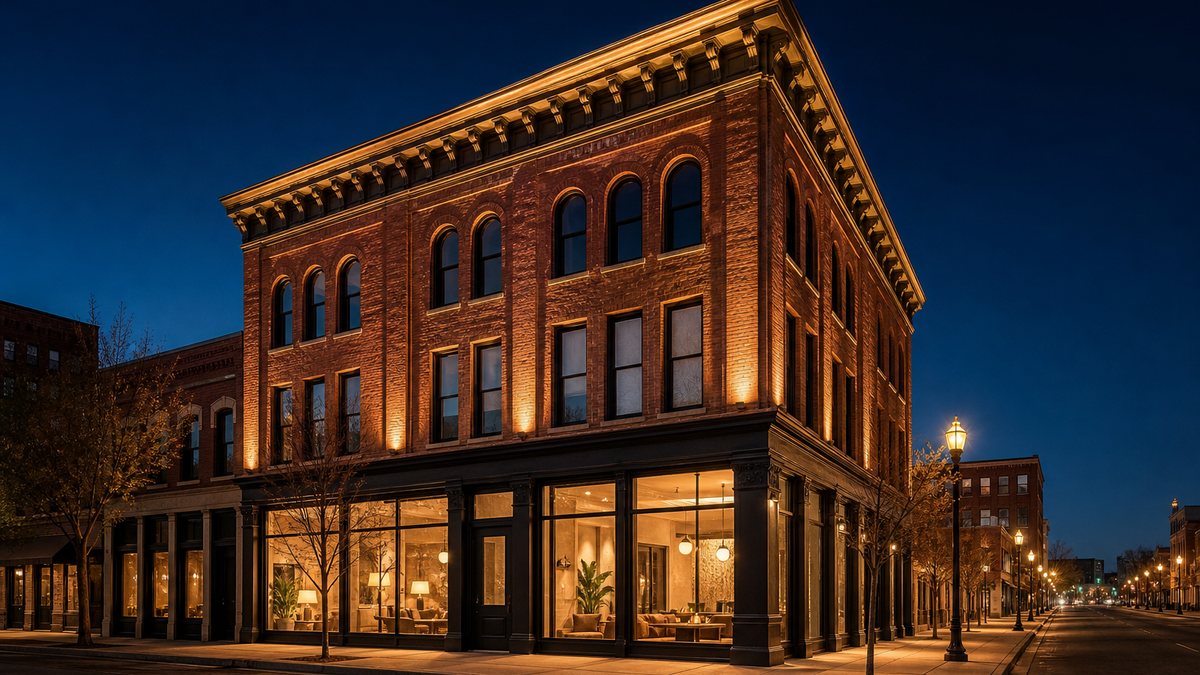
Historic building lighting in Fort Worth is about more than making an old building bright at night. Done well, it reveals the brick, limestone, terra cotta, cornices and carved details that make the city's older buildings special, while protecting the materials that cannot be replaced. Done poorly, it drills holes through century-old masonry, floods facades with flat, glaring light, and leaves a tangle of conduit across a landmark that took decades to earn its character.
Fort Worth has a deep stock of historic architecture: brick commercial blocks Downtown and along the old streetcar corridors, the livestock-era buildings of the Stockyards, early twentieth-century churches, schools and theaters, warehouse and industrial buildings converted into lofts, offices and restaurants, and the homes and small commercial buildings of the city's local historic districts. Many of those buildings are now being restored and reused, and owners want lighting that is modern, efficient and easy to maintain without compromising what makes the building worth saving.
This guide is written for building owners, developers, property managers, architects and preservation-minded tenants. It covers exterior facade lighting, storefronts and signage, interior lighting for restored spaces, historic fixture retrofits, the city's Certificate of Appropriateness process, energy code considerations, installation methods that protect masonry, and how to plan a project from survey to switch-on. For broader facade techniques on newer buildings, see our architectural LED lighting guide.
Good historic building lighting in Fort Worth usually means:
- Light the architecture, not the wall: grazing for texture, accent light on cornices and columns, soft washing where a broad glow suits the design
- Warm, high-quality white light: warm color temperatures and high color rendering that flatter brick, stone and wood
- Reversible, low-impact mounting: anchors in mortar joints, existing openings and concealed positions, never through character-defining features
- Hidden wiring and small fixtures: compact LED fixtures that disappear by day
- Restore before replacing: historic lanterns, sconces and pendants retrofitted with LED where possible
- City review first: exterior changes to designated historic properties need a Certificate of Appropriateness before permits or work
- Controls: dusk-to-dawn scheduling, dimming and late-night reduction
- Pricing: a project-specific proposal after a site survey
Why historic buildings need a different approach
A modern glass office tower and a 1910s brick commercial building may sit on the same block, but they should not be lit the same way. Historic buildings bring a few challenges and opportunities that change every lighting decision:
- The materials are irreplaceable. Original brick, cut stone, terra cotta, cast iron and old-growth wood cannot be swapped out like a metal panel. Every anchor, drill hole and cable route matters.
- The details are the point. Cornices, corbelling, arches, pilasters, window hoods and ghost signs are what people notice. Lighting should bring those features forward instead of flattening them.
- Review processes apply. Designated landmarks and properties in local historic districts go through city review for exterior changes, and buildings using historic tax incentives may have additional review.
- Access and wiring are harder. Thick masonry walls, plaster ceilings, limited chases and no modern raceways make wiring routes a design problem in their own right.
- The building has a story. A good lighting plan respects how the building was meant to look, including its original lanterns, storefront glow and signage, rather than imposing a look it never had.
Preservation principles that shape the lighting plan
The Secretary of the Interior's Standards for Rehabilitation, published by the National Park Service, are the national reference point for rehabilitating historic buildings, and many local commissions use them or guidelines based on them. Several of the standards translate directly into lighting decisions:
- Retain historic character. The standards say the removal of historic materials or alteration of features and spaces that characterize a property should be avoided. Lighting should not require cutting into, covering or removing those features.
- Preserve distinctive features and craftsmanship. Ornament, finishes and construction techniques should stay visible and intact, which is why small, carefully placed fixtures are preferred over large brackets on a facade.
- Repair before replacing. Deteriorated historic features are repaired rather than replaced where possible. For lighting, that means restoring and retrofitting original fixtures before buying new ones.
- Avoid a false sense of history. Conjectural “old-looking” fixtures that the building never had can be just as inappropriate as modern ones. Where historic fixtures are missing, photographs or physical evidence should guide replacements.
- No damaging treatments. The standards warn against chemical or physical treatments that damage historic materials. Aggressive drilling, adhesives that stain stone and fixtures that trap water against masonry fall into the same spirit.
- New work should be reversible. New additions should be built so that, if removed later, the essential form and integrity of the property would remain unimpaired. Lighting is a classic reversible layer: done right, it can be removed decades from now with little trace.
These principles are not just for formal landmarks. Any owner of an older building gains from following them, because they protect the very character that gives the building its value.
Exterior facade lighting techniques
The right technique depends on the material, the depth of the details, where people will view the building from and what the owner wants it to communicate at night.
Grazing
Grazing places linear LED fixtures very close to the wall, aimed almost parallel to its surface. The low angle throws shadows from every brick edge, rusticated stone block and mortar joint, making texture leap out. It is often the best way to light rough masonry, but it will also reveal every patch, crack and uneven repair, so the facade's condition should be reviewed first.
Accent lighting
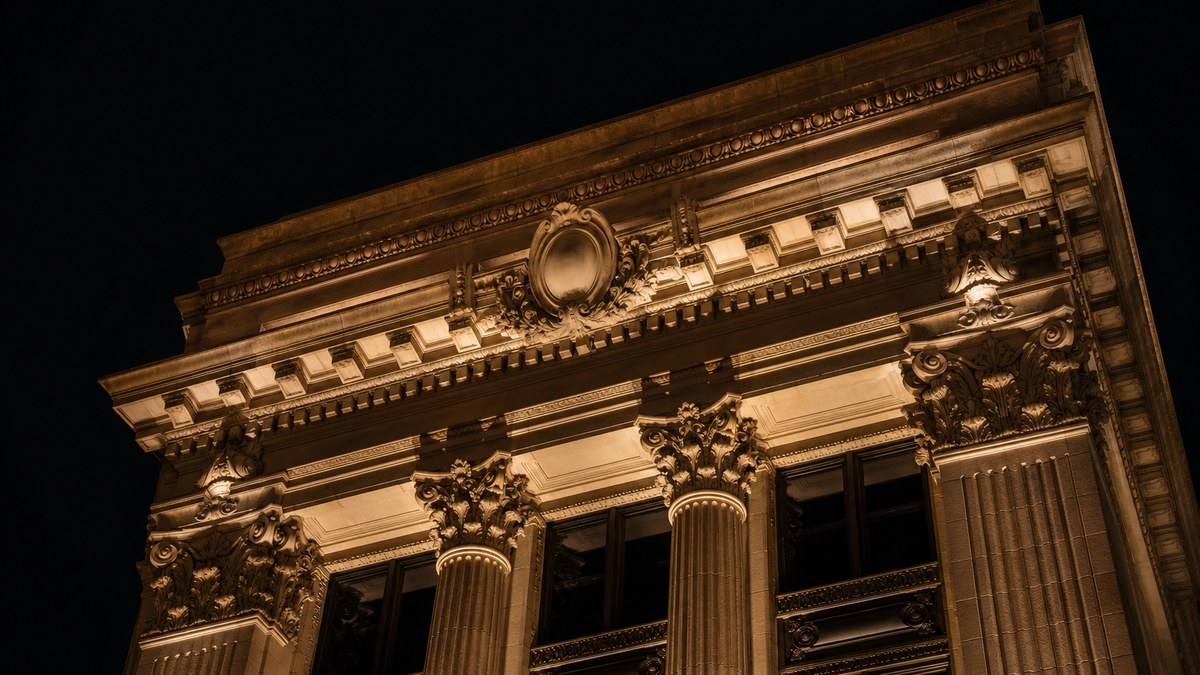
Small, narrow-beam fixtures pick out specific features: a cornice, a carved panel, columns at an entrance, a date stone or a tower. Accent lighting creates hierarchy, so the building reads as architecture rather than a lit box. On ornate facades, light from slightly below and to the side models three-dimensional detail far better than straight-on light.
Washing
Wall washing spreads soft, even light across a broad surface. It suits smooth stucco, painted brick or a plain upper wall that frames more detailed areas below. Too much washing flattens texture, so it is usually combined with accent light.
Window and interior glow
Some of the most beautiful historic buildings at night are lit mainly from inside. Warm light behind upper-floor windows, transoms and storefront glass makes a building look occupied and alive, and avoids putting any fixtures on the facade at all. For churches and buildings with stained or leaded glass, interior light can make the windows glow outward after dark.
Silhouette and rooftop features
Parapets, towers, water tanks and rooftop signs can be lit from concealed rooftop positions. Careful aiming keeps light on the feature and out of the sky.
| Facade feature | What to show | Typical LED approach |
|---|---|---|
| Rough brick or rusticated stone | Texture and depth | Linear grazing from the base or a ledge |
| Cornice and parapet | The building's crown | Concealed linear or narrow accent lights on the ledge below |
| Columns and pilasters | Vertical rhythm | Narrow-beam uplights at the base, tightly aimed |
| Storefronts and transoms | An active, welcoming street level | Interior display lighting, concealed soffit lights, restored lanterns |
| Arches and carved entrances | Craftsmanship and the way in | Small accent fixtures, warm downlights inside the entry |
| Towers and steeples | A landmark on the skyline | Rooftop or ledge accent lights with glare shields |
| Painted ghost signs | History on the wall | Soft, even wash with very low heat and no UV concern |
| Stained and leaded glass | Glow from within | Interior lighting behind the glass, separately controlled |
Color temperature, color rendering and brightness
Light quality matters even more on old materials than on new ones. A few rules of thumb guide most historic projects:
- Warm white usually wins. Many historic facades look their best under warm light, often around 2700K to 3000K, which brings out the reds and browns in brick and the honey tones in limestone. Cooler light can make the same materials look gray and flat. These are typical design ranges, not rules, and mock-ups on the actual wall are the best way to choose.
- High color rendering. Fixtures with strong color rendering show the true color of brick, stone, painted trim and wood. Low-quality LEDs can turn red brick muddy.
- Consistency. Every fixture on a facade should match in color temperature and tint. Mixed sources look patchy, especially from across the street or on camera.
- Less is more. A historic facade does not need to compete with a modern billboard. Moderate, well-placed light looks richer than overpowering brightness, and it respects neighbors and the night sky.
- Color effects with restraint. Color-changing fixtures can be useful for holidays or civic events, but most historic buildings look best in warm white most of the year.
Mounting and wiring without damaging the building
This is where historic lighting projects succeed or fail. The goal is lighting that can be removed later with almost no trace:
- Anchor into mortar joints, not masonry units. Historic district design guidelines commonly recommend setting anchors into the mortar joint rather than through the brick or stone itself. Mortar can be repointed; a cracked brick or chipped stone cannot be easily replaced.
- Use corrosion-resistant hardware. Stainless steel anchors and brackets avoid rust stains running down light-colored stone.
- Reuse existing openings. Old sign anchors, abandoned conduit holes and existing penetrations are often the best places to bring power through a wall.
- Hide fixtures in shadows and ledges. Cornice ledges, window sills, parapet backs, canopies and storefront soffits can hold compact fixtures that are invisible from the street by day.
- Route cables with care. Run wiring along mortar lines, behind downspouts, inside existing chases or through the interior, and paint any exposed conduit to match the masonry.
- Protect against water. Fixtures and penetrations must be sealed so that water does not enter the wall, and fixtures should never trap moisture against soft brick or stone.
- Test before committing. A temporary mock-up on the actual facade confirms aiming, brightness and color before a single permanent hole is drilled.
Electrical work on any building must still follow the electrical code and be performed by licensed electricians. In Fort Worth, electricians are licensed through the Texas Department of Licensing and Regulation, and the city adopted the 2026 National Electrical Code effective September 1, 2026.
Light your landmark without harming it
Tell us about your building and goals. We will survey the facade and interiors and prepare a project-specific proposal.
Historic storefronts, signage and street level
The ground floor is where most people experience a historic building, especially in walkable areas such as Downtown, the Stockyards and older neighborhood commercial streets. Good storefront lighting helps both the building and the business inside it:
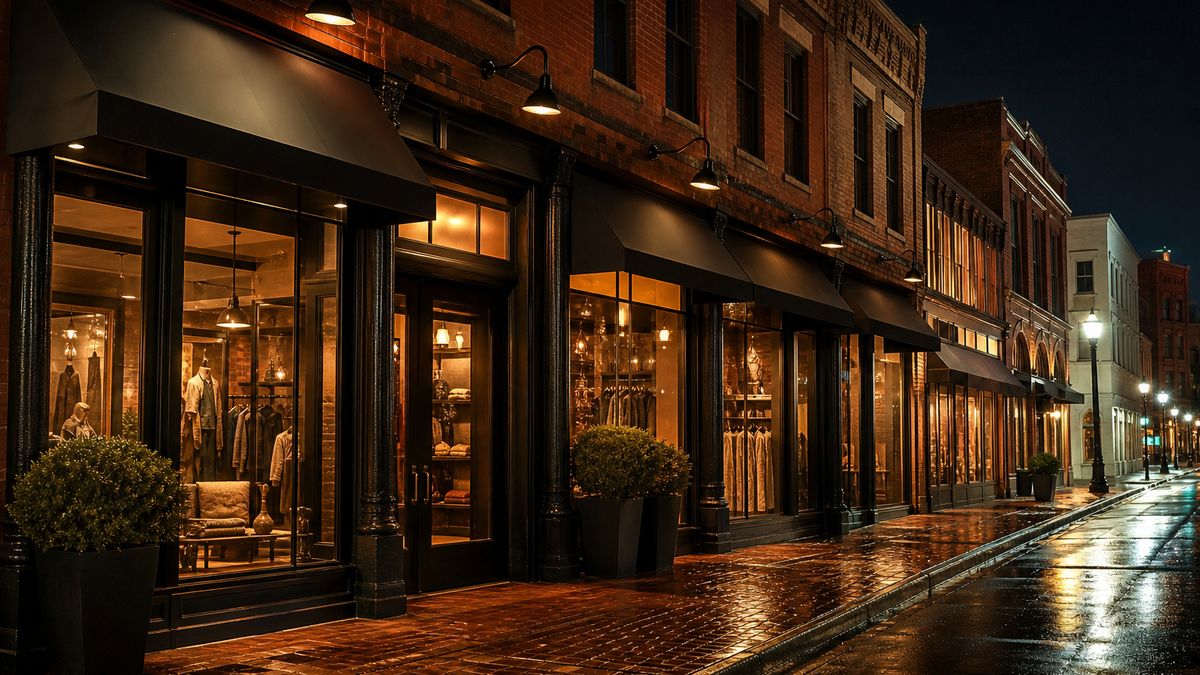
- Display windows: warm, glare-free LED track or concealed fixtures light merchandise and let the storefront glow after hours.
- Transom windows: a soft line of light behind transoms highlights a classic storefront feature many owners forget.
- Entry lighting: restored or compatible lanterns and recessed downlights in the entry make the door easy to find and safe to use.
- Sign lighting: gooseneck fixtures, halo-lit letters and restored neon-style signs can all suit historic streets when sized and placed carefully. In historic districts, new signs and sign lighting are part of the exterior review.
- Canopies and awnings: small downlights under a canopy light the sidewalk without putting fixtures on the facade.
Our LED signs guide covers sign lighting options in detail, and for full sign fabrication we work with American LED Signage. For restaurants and bars that occupy historic buildings, our restaurant lighting guide covers dining rooms, bars and patios.
Interior lighting for restored historic spaces
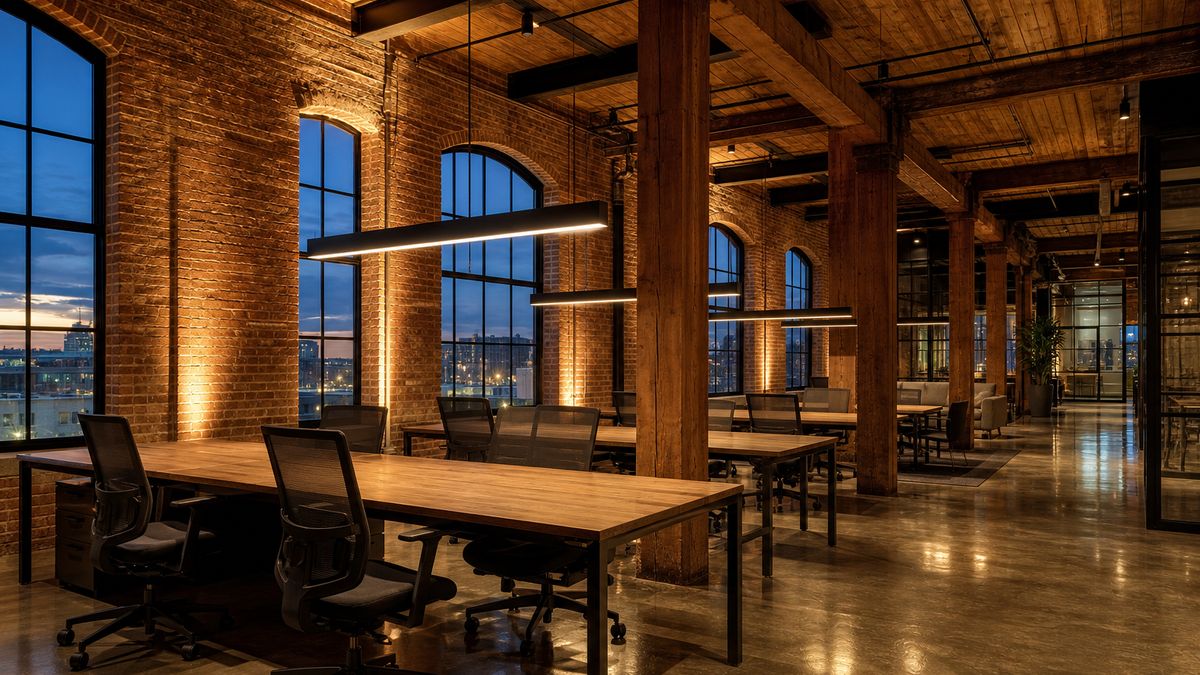
Inside, historic buildings often have exactly the features designers love: tall ceilings, exposed brick, heavy timber, pressed-tin ceilings, plaster cornices, terrazzo or wood floors and big windows. Lighting should celebrate those features while meeting modern needs for offices, retail, hospitality and residential use.
- Avoid dropped ceilings where possible. Suspended or track-mounted LED systems and pendants keep tall ceilings and decorative surfaces visible.
- Graze exposed brick and timber. Linear fixtures along a wall or beam make interior masonry a feature instead of a dark backdrop.
- Uplight decorative ceilings. Pressed tin, coffered and plaster ceilings come alive with indirect light from coves, ledges or pendants.
- Keep fixtures compact and reversible. Surface raceways painted to match, low-profile track and wireless controls reduce cutting into plaster and lath.
- Layer task light. Offices and workrooms need comfortable, glare-free task lighting; it can come from pendants, desk lighting or discreet linear fixtures rather than a grid of ceiling panels.
- Mind the heat and UV. LED produces far less heat than older halogen or incandescent sources and emits little ultraviolet, which helps protect wood finishes, fabrics, artwork and archives.
Converted warehouse and industrial buildings have their own needs, with open ceilings and long spans; our warehouse LED lighting guide and commercial LED lighting services page cover interior options for larger spaces. Boutique hotels in older buildings can borrow ideas from our hotel lighting guide.
Restoring and retrofitting historic light fixtures
Original lanterns, sconces, chandeliers, pendants and theater fixtures are often among a building's most character-defining features. Before replacing them, consider restoration with LED:
- Assessment: each fixture is reviewed for condition, wiring, sockets, glass and finish.
- Rewiring: brittle cloth or old insulated wiring is replaced to meet current safety standards.
- LED retrofit: filament-style LED lamps or custom LED modules preserve the look of a glowing lamp while cutting energy use and heat.
- Dimming: compatible LED drivers and dimmers allow smooth dimming without flicker or buzz, which older fixtures never had.
- Glass and finish care: original glass shades and finishes are cleaned gently and preserved wherever possible.
- Documented replacements: where fixtures are missing, historic photographs or matching surviving fixtures guide replicas, avoiding guesses about what the building had.
Fixture restoration also reduces maintenance: long-life LED lamps mean fewer lift rentals to reach chandeliers in tall lobbies or sanctuaries. Our church lighting guide covers chandelier and pendant retrofits in historic sanctuaries specifically.
Fort Worth review: Certificates of Appropriateness
If your building is a designated Historic and Cultural Landmark or sits in one of Fort Worth's local historic districts, the city's historic preservation rules apply before any exterior lighting is installed. According to the City of Fort Worth's Historic Preservation page, any changes to the exterior of historic properties require a Certificate of Appropriateness before permits are issued or construction begins. Most cases can be approved administratively by staff, while the Historic and Cultural Landmarks Commission, an eleven-member volunteer body appointed by the Mayor and City Council, reviews items such as new construction, demolition, design-guideline waivers and appeals.
The city's local historic districts include Fairmount, Historic Carver Heights, Morningside, Elizabeth Boulevard, Chase Court, Hillcrest, Linden Avenue, Terrell Heights, the Stockyards, Mistletoe Heights, Central Handley, Garden of Eden, Kenwood Court and W. A. Powers. Each district may have its own design guidelines, and commercial areas such as the Stockyards draw particular attention to signs and visible changes.
A few practical tips for lighting applications:
- Apply early. Build review time into the schedule, especially for visible facade work.
- Show the fixtures. Include cut sheets, sizes, finishes and mounting details.
- Show the effect. Renderings or mock-up photos help reviewers understand the result at night.
- Explain reversibility. Describe how fixtures are anchored in mortar joints or existing openings and how wiring is concealed.
- Address glare and sky glow. Shielded, tightly aimed fixtures and scheduled dimming show respect for neighbors.
The city also offers a Historic Site Tax Exemption program for qualifying rehabilitation of designated properties; the city's page notes that applications must be submitted before work begins. Lighting may be part of a broader rehabilitation, so owners pursuing incentives should talk with city preservation staff and their tax advisors early. We do not provide tax or legal advice.
Energy code and historic buildings
The City of Fort Worth uses the 2015 International Energy Conservation Code with local amendments, with ASHRAE 90.1 as an alternative compliance path, along with the 2021 International Building Code, Fire Code and Existing Building Code. The IECC includes a historic buildings provision: where a report signed by the owner, a registered design professional or a historic preservation authority shows that compliance would threaten, degrade or destroy the historic form, fabric or function of the building, certain requirements may not be mandatory. Whether and how that applies to a particular project is up to the code official.
In practice, LED lighting rarely conflicts with preservation. Modern LED systems, controls and occupancy sensors can usually meet or exceed energy code expectations without harming historic fabric, so most owners treat the code as a design target rather than something to avoid. Your design and installation team should confirm the requirements for your project with the city.
- Exterior controls: automatic dusk-to-dawn operation, schedules and late-night reduction keep facade lighting efficient.
- Interior controls: occupancy sensors, time switches and dimming are easy to add with wireless controls that avoid new wiring through plaster.
- Emergency and egress lighting: restored lobbies, stairs and assembly rooms still need code-compliant emergency lighting, which can be integrated discreetly.
For buildings planning networked controls, our PoE lighting systems guide explains how low-voltage networked lighting can reduce new line-voltage wiring in some interiors, though codes and licensing still apply.
Planning a historic lighting project
- Goals and history. We start with what the owner wants the building to communicate and what is known about its history, original fixtures and past alterations.
- Site survey. We walk the building by day and at night, document facade materials and condition, existing fixtures, power sources, access and the surrounding lighting.
- Preservation check. We identify whether the building is designated or in a historic district and what review will be needed.
- Lighting concept. Techniques, fixture types, color temperature and control strategy are chosen for each part of the building.
- Mock-up. Temporary test fixtures on the facade or in key rooms confirm the look before anything is installed.
- Documentation. Fixture cut sheets, mounting details and renderings support the Certificate of Appropriateness and permit applications.
- Proposal. A clear scope, phasing plan and project-specific price.
- Installation. Licensed electricians install with masonry-safe methods, concealed wiring and careful protection of finishes.
- Aiming, programming and handover. Every fixture is aimed at night, schedules and scenes are programmed, and the owner receives documentation for maintenance.
Our LED light installation guide explains this process from site walk to switch-on, and our Luminance design-build program handles complete lighting transformations from concept to commissioning.
Common historic lighting mistakes
- Floodlighting the whole facade. Big floodlights from across the street flatten detail, cause glare and spill light into windows and the sky.
- Drilling through brick or stone. Anchoring into masonry units instead of mortar joints causes permanent damage.
- Cool, low-quality light. Harsh, cool white with poor color rendering makes warm brick and stone look dull and gray.
- Exposed conduit everywhere. Unplanned conduit runs across a facade can do more visual harm than the lighting does good.
- Fake “historic” fixtures. Mass-market colonial-style lanterns on a building that never had them create a false history.
- Throwing away original fixtures. Historic lanterns and chandeliers are often worth restoring and retrofitting.
- Skipping review. Installing facade lighting on a designated property without a Certificate of Appropriateness can lead to delays or required removal.
- Grazing a damaged wall. Grazing reveals every flaw; masonry repairs may be needed first.
Energy savings, maintenance and incentives
Replacing incandescent, halogen, fluorescent and metal halide lighting with LED commonly reduces energy use substantially, and controls add further savings. For historic buildings, the maintenance benefits can matter just as much: long-life LED fixtures mean fewer lift rentals and fewer people working on fragile cornices, chandeliers and high ceilings. Lower heat output also reduces stress on old finishes and fabrics. Commercial LED lighting projects in the Oncor service area may qualify for energy-efficiency incentive programs, depending on the project and current program availability. Qualifying products such as DLC-listed fixtures are typically required, and incentives are usually arranged through participating service providers before work begins.
Why owners choose Fort Worth LED Lights
We coordinate historic building lighting from the first survey to the final aiming session: design, mock-ups, fixture selection and restoration, documentation for city review, installation by licensed electricians, controls programming and ongoing service. Our team brings 15+ years as an authorized architectural lighting dealer and project coordinator. Our licensed installation partner has completed over 200 major sports and commercial projects across the US and Canada — NFL, NBA, NHL, MLS, NCAA and NASCAR. We serve owners across Fort Worth and Tarrant County; see our service areas, our full list of lighting services and our architectural lighting services. If an existing facade system has failed, our repair and service team can help, and for site lighting around older properties see our Fort Worth outdoor LED lighting guide and parking garage LED lighting guide. For lobbies and event spaces that need displays, see our LED video walls guide.
Frequently Asked Questions
What is the best way to light a historic building facade?
Do I need city approval to add lighting to a historic building in Fort Worth?
How do you mount lights without damaging historic masonry?
What color temperature is best for historic brick and stone?
Can original historic light fixtures be converted to LED?
How much does historic building lighting cost in Fort Worth?
Does the energy code apply to historic buildings?
Will facade lighting cause glare or light pollution?
Do historic lighting projects qualify for incentives?
What areas do you serve?
Bring your historic building back into the light
Request a site survey and we will follow up to walk the building by day and at night.
Related
Our DFW lighting network: Dallas commercial LED lighting, Arlington LED lighting, Irving LED lighting, Plano LED lighting, statewide Texas LED lighting, wholesale LED components, fiber optic starlight ceilings, 360° fiber optic lighting, premium pool lighting, modular building solutions, and Dallas modular structures.